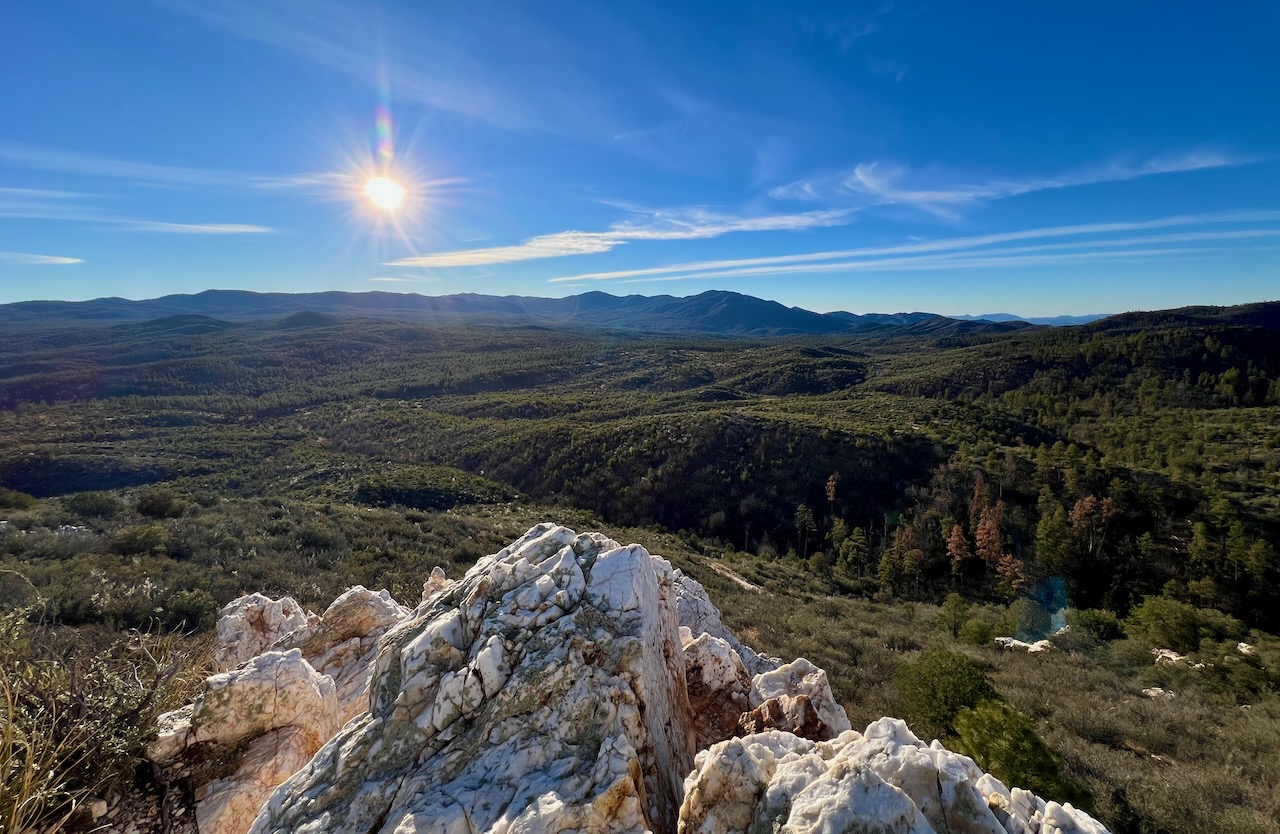
On this month’s winter solstice morning, the angular geometries atop Quartz Mountain reflect the sunrise with a determined, bespeckled albedo. The white quartz ledges invite reflection on their own terms, thrust upward as a beacon among the neighbouring volcanic and granitic hills south of our recently adoptive Arizona hometown.
These rocks are pieces of an epoch-old puzzle in stone that predates any of the stories that would subsequently fit them into narratives of reverence, reverie, enclosure, extraction, and conservation.
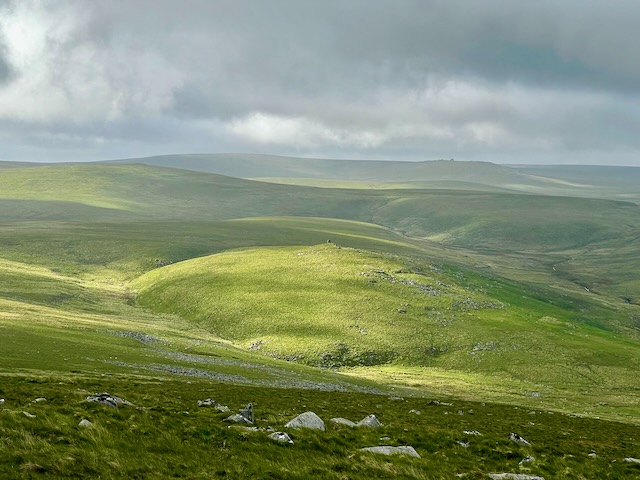
In my own reflections on this my fifty-fifth winter solstice, I find I’ve been drawn as much to this quartz’s sharp corners as I am to the rounded, besodden, deep green swales of Dartmoor on England’s southwestern coast — these hills, too, capped by aging granite tors (so captivating in their viridescence that I ran to more than 250 of them in my five years in the West Country). Dartmoor’s soft, rounded landscape is less about edges than envelopment; even atop the highest of tors, the misty weather is often resolutely introspective.
As we near the end of the year and settle in for longer, darker nights, and in this hemisphere, the tilt of the Earth seems to come closest in its orbit to the edge of possibility, I myself feel closest to this permeable edge. For a long time, I’ve been drawn to the blurriness of and richness of between-spaces — of land, of place, of culture, of genre, of time. In retrospect, this no doubt gave rise to my Climate Run project more than a decade ago; to seek out places in the Arctic and Subarctic (Iceland, Svalbard, The Faroes, Norway, Sweden, Finland, Newfoundland, and more) where the earth is more visible, mutable, and upon which our impact is often most clearly perceived.
Although our days have now grown longer in anticipation of the new year, in these shorter days, the mythic is often invoked and applied as a salve for the quotidian, and we invite the light into our long dark nights, the better to tell stories by; the thinning of this edge between things also invites a letting go.
December has also been witness in my own life to the births of both my son and of my late father, and though they were born 70 years and 5 days apart, and though they were bereft of more than two winter solstices together, there is between them a clear fluidity of time and experience that overspills its banks each year as our hemisphere starts its slow tilting back toward the sun. I am so deeply proud of them both, and can only aspire to live up to both my father’s past achievements and those my son has yet to do.
This season of solstice, celebration, and the turning of the year invites introspection, retrospection, and prospection of all kinds, with a turn toward speculation as we look ahead to this century’s second quarter, encouraged to consider what might be possible. As seductive as it may be to seek solutions to our present challenges in an aspirational future tense, our futures are always borne of our present, and in finding time to fully inhabit and embody our shared moments, angular or undulating as they may be.
“Resistance . . . is not a separate force, but comes from the flow itself, and enables the unfolding of what in it is always potentially there; it precipitates the collapsing of its own potential into the actual” (Iain McGilchrist, The Matter with Things)
I picked a basket of apples from our campus at Prescott College today, both as a harvest of memories and of possible futures.
Every college at which I’ve had the honour of taking a leadership role, we have held an annual apple pressing — harvested in turn from Sterling College’s Vermont hillsides, Schumacher College’s centuries-old trees (mixed as they were amongst medieval quince and ancient medlar trees) in southwestern England, and Prescott College’s more recently cultivated varieties suitable for the higher climate of north-central Arizona. In the 1990s, I was fortunate to work at an apple farm in western Maine. Part of the work there, too, was pressing countless bushels of fallen apples into cider between folded felt and wooden slats with a 19th-century hydraulic press.
Apples, juice, and cider have for me been a connective flow across bioregions, communities, and continents. At Schumacher, we pressed apples in a wooden barrel press and filled hundreds of bottles with juice to be served with meals throughout the seasons; years later, the flavour of dried fruits mixed with porridge alongside juice bottled by the community the year before lingers in my memory.
Earlier this month, Prescott College’s own Harvest Festival invited students, staff, families, and friends to share in a meal and cider pressed (often by eager children shepherded by our students) from the trees whose boughs still held unharvested apples just above.
“May something go always unharvested! May much stay out of our stated plan” (“Unharvested,” Robert Frost)
When I returned today to pick a few apples for my own family, I left many dozens behind, some still low enough for deer, higher ones for birds and squirrels. My harvesting was part of an ancient ritual, which echoes backwards through shared histories and forward in a dialogue with infinite narratives of possibility. Fermented, or ‘hard’ cider (in the UK, simply ‘cider’) is itself a process of alchemic transformation. Patience, both in the cultivating, grafting, nurturing to fruition — and in the bottling, storing, and fermenting — is critical.
You can’t rush apples.
“I’ve become a lover of slowness, patience, endurance, and long-term vision, because these things see, like crucial equipment for changing the world or even understanding it” (Rebecca Solnit).
Picking an apple from a tree is, then, only a small part of a process, the outcome of which can be as infinite as the unexpected flavours of wild apples from trees thickened by animal browse — whether eaten fresh, baked, sauced, juiced, canned, dried, or fermented. As a sometime writer, I can’t help but think about those possibilities when the trees blossom in the springtime, full of stories and promise, and, in cooperation with their stewards, speak to a resilient yet unknowable future.
“Books have plots, because they are finite and authored; the world has an infinite number of authors, of whom you are one, and the surprising outcomes are often due to underestimated agents” (Rebecca Solnit)
This movement and its manifestations, with which I’ve been preoccupied for the better part of a decade, have come to adumbrate the infinite unknowable — whether the apeiron of Anaximander’s world, the vortex of Democritus, Lucretius’s clinamen, or Siddhārtha’s Nirañjanā. The celestial nature of apples left unharvested on the uppermost boughs, dark against the bright Arizona sky, connected as they are to histories and futures alike, invites us to consider, as Thomas Nail writes, “the material conditions for the emergence of things are themselves not things,” or, more pointed still: “Movement is reality itself” (Henri Bergson).
With this in mind, I reach to pick another apple — seeking one not yet split by the heat or prised open by birds or squirrels — both as labour of love and metaphor for the heavy lifting that lies ahead, because, as Audre Lorde writes, “to refuse to participate in the shaping of our future is to give it up. . . . Each of us must find our work and do it.”
Maybe it was the autumn foliage on the verge of turning along the riverbanks and edges of New Hampshire fields, themselves having turned into palettes of ochre and sepia from weeks of late-summer drought — perhaps it was the deepening topography as I drove further north — or likely also it was the late afternoon sun reflecting off the rippling surface of the Pemigewasset River, wider here north of Plymouth, as it makes its way from sources in the White Mountains miles to the north. Whatever the reason, the slightest seed of a Robert Frost poem, like a brilliant white tuft of milkweed on a gossamer wind, made its way into my consciousness. The one line ‘and we lose all manner of pace and fixity in our joys and acquire a listening air’, from his poem ‘The Sound of Trees’ started as a kernel and grew layer by layer to my remembering the whole of the poem by week’s end.
Pemigewasset River at Livermore Falls
My talk at the Museum of the White Mountains, titled ‘Interwoven Ecologies: Movement and Regeneration in a More-than-Human World’ had Frost’s concept at its very heart — that at our core we are an ‘expression of forces’ of both human and more-than-human worlds, a recognition of a de-centering that can dramatically empower us to engage in the questions of relationality, agency, and more.
In his context, Frost limned a relationship with trees as sentient and relational beings and brought readers into a receptive mode while acknowledging the movement-centered existence that the trees, while perhaps outwardly sedentary, expressed both to and through us — as co-inhabitants of the poem and the transformative power of human/more-than-human relationality.
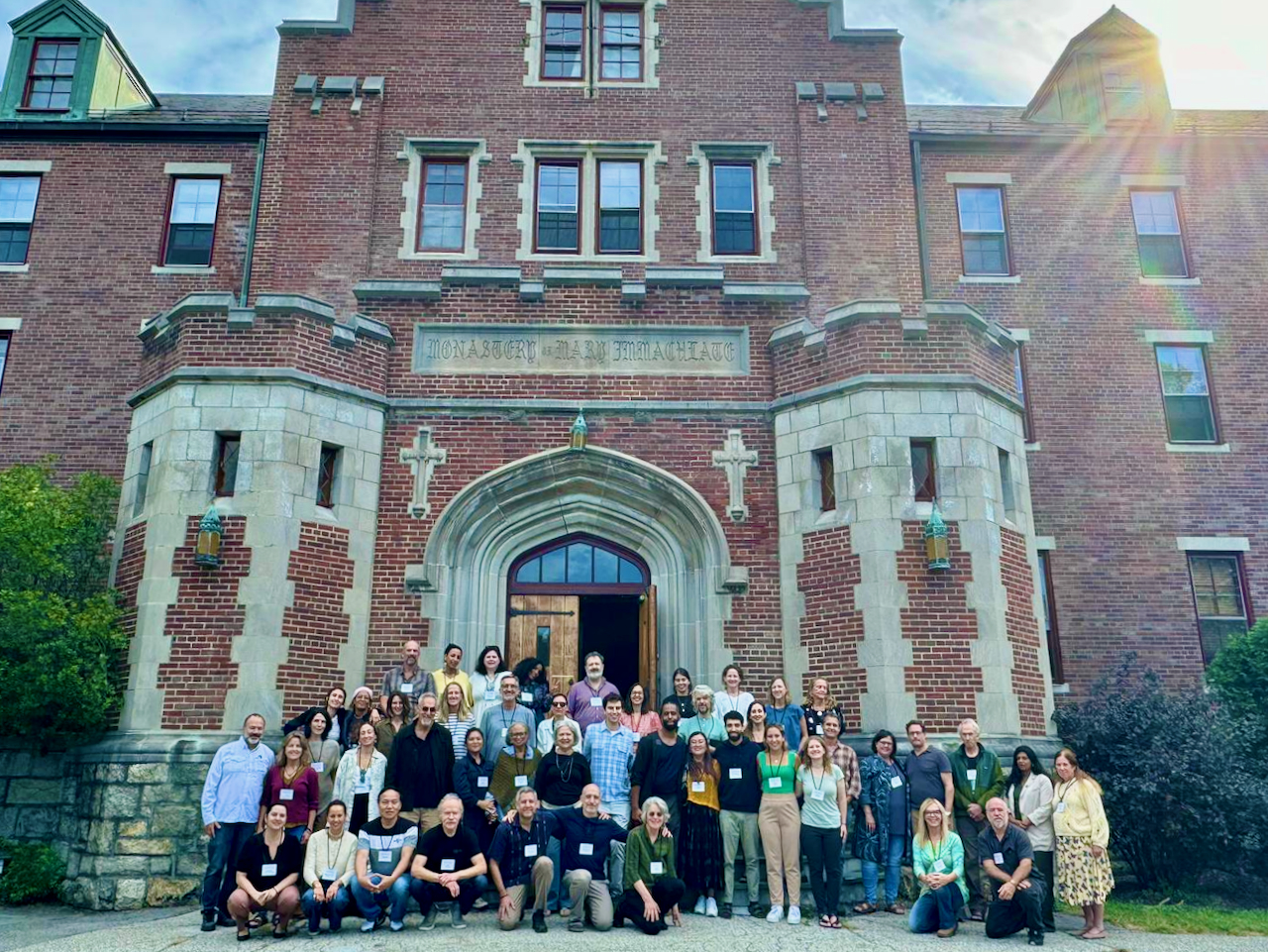
Frost’s poem stayed with me as I shared the second part of the week at the Garrison Institute in New York’s Hudson River Valley with a wonderful group of approximately sixty leaders from all over the world in conscious food systems, planetary health, regenerative learning, agriculture, consciousness studies, funding, global networking, climate change activism, indigenous ways of knowing, and more — from academia, yes, but largely from practitioners and the non-profit and advocacy sector — to explore how the implementation of consciousness and regenerative practices can help transform food systems at scale.
The Garrison Institute
The questions that surfaced & ideas we shared in our three days at Garrison resonated with my reading of Frost’s poem earlier in the week, and his words kept creeping into the margins of my notes as we shared initiatives on regenerative practice as a ‘process of rebuilding and renewal of the common ground from crisis and collapse to regeneration and renewal’ (Hannah) in the hope that we can reshape and ‘affect value changes and lead to deeper conscious change’ (Andrew) in a reimagination of a range of practices, including an educational framework inviting learners and communities of practice to counter a prevailing exploitative growth-minded outlook and ultimately asking, ‘why are the questions what they are? — and why are the research methodologies shaped the way they are?’ (Nicole)
There were so many layered conversations that engaged with/in the full spaciousness of the former Capuchin Monastery on the banks of the Hudson that it may take months to see how some of the newly spun threads of inquiry will find one another to weave into a more conscious and holistic future for both food systems and broader regenerativeness into which I hope we can see them evolve. Despite the fertility and depth of conversation, and the spaciousness and time, there was an underlying urgency as we sought to find the leverage points where these seeds of radical growth could find fertile soil in which to flourish.
At the same time, I was reading Marica Bjornerud’s wonderful Timefulness, which, with a deep understanding of geomorphology in the context of a contemporary worldview that ‘represents an “epistemic rupture so radical that nothing of the past survives”‘ (161). To help us unmoor from the ‘Island of now’ and destabilize our fixation on the present, Bjornerud invites us to collectively find a way ‘how to turn rocks into verbs’ (61) in order to recognize our own temporal geopositionality in the context of a prevailing seismodynamic and tectonokinetic fluidity.
Bjornerud’s lithico-philosophical sedimentations couldn’t help but send me to my bookshelf seeking my well worn and now fifteen-years’ old reading of Stones of Aran, to find where Tim Robinson similarly asks, ‘what tense must I use to comprehend memories, memories of memories of what is forgotten, words that once held memories but are now just words?’ (8). Exceptional details of the Aran Islands percolate upwards through the karst landscape to momentarily coalesce in turloughs, ‘letting the island recompose itself as music’ through the fluidity of its seasonal movements — ‘Il cimento dell’armonia e dell’inventione’ forever cast and recast along this unmoored archipelago in the North Atlantic.
Farther west still and even farther north, on ᐅᒥᖕᒪᒃ ᓄᓇ, Umingmak Nuna, Land of the Muskox (also known as Ellesmere Island) in northern Nunavut, Robert Frost’s un-fixity leads me (during my long drive back from the Hudson to Boston for my flight home) to Aritha van Herk’s exercise in un-reading along the shores of Lake Hazen, well above the Arctic Circle at some 81°N. As she seeks to reclaim the eponymous character from her well-worn copy of Anna Karenina to ‘free her from her written self’(119) on the remote island that does not permit ‘such bare-faced superficiality’ (94) ‘within this endless light [where] she resists all earlier reading’ (121). For centuries, the far north has itself been written into the psyche of so many in the south as a fixed imaginary (a place, an idea, a feeling, a place of both possibility and fear), so a critical un-reading of a fiction in the reality of an all-too-often mythologized place seeks (not unproblematically, certainly) to re-situate, re-name, de-colonize fictionalized bodies and terrain. It’s much as Alootook Ipellie underscores in his Arctic Dreams and Nightmares, ‘The Arctic is a world unto its own where events are imagined yet real and true to live, as we experience them unfolding each day’ (xix).
Summer in the Scandinavian Arctic
Van Herk takes her tack with the wind flowing through Frost’s trees upon the waters rising and falling in Robinson’s turloughs as she un-reads and re-writes self, text, and terrain in a kind of reclamation—a way of freeing bodies and places from a framework of imposed, static, and ultimately marginalizing static narratives.
This work of unsettling static narratives, then—whether of bodies, language, places, or time—reveals the movement inherent at the heart of both human and more-than-human worlds. A resistance to fixity allows us to see the networks of interconnected movements that define us: wind through the trees, seasonal flux of water across landscapes, words within a narrative and the shifting contours that limn our collective and individual understandings. Much as we engaged in practice and conversation at the Garrison retreat last month, where we explored the intersections of consciousness, transformative food systems, and planetary health, this disruption of imposed frameworks encourages a deeper engagement with complexity and relationality. By un-reading and re-imagining these static frameworks (literary, human, and ecological alike), we open pathways for radical, root-deep transformations.
In embracing this dynamism, we re-inhabit these spaces, liberating not only the land and its stories but also ourselves. We are reminded that regeneration—of ecosystems, food systems, education, and consciousness—requires a willingness to disrupt and reshape what has been fixed, opening new possibilities for agency, interdependence, and renewal. Disrupting fixity is not just an intellectual pursuit, but a lived practice, grounding us in the work of reimagining and regenerating our shared futures.
Unde aether sidera pascit? Lucretius, De Rerum Natura I.231
On this World Philosophy Day, I find myself in the not-always comfortable position of recognising just how the ever-present movement of our world can pull, unravel, remake, and how stillness and rest are nonetheless intrinsic elements of our general dance through the world.
Yesterday saw me at the gym, perhaps embodying this (non)contradictory complexity when I was walking (rather than running) uphill (on a level floor) on a treadmill (rather than outside) as I continue to rehabilitate following a vertebra fracture after a fall 16 days ago. I counted the fractional kilometres as they digitally ticked by, watched the slope increase on the screen as I felt it steepen beneath me, and, over the better part of an hour, got nowhere at all, although my watch registered I’d walked precisely 5k.
Movement has been a profoundly important part of my life — across personal achievements and aspirations through my endurance running Climate Run project — and professional initiatives like designing the MA Movement Mind and Ecology at Schumacher College, undergraduate trail running and climbing courses I taught at Sterling College, and more recently an evolving engagement with networks and relationships, which draws from a life woven many strands, though here principally from my more than 30 years of endurance running and 20 years of academic leadership to help inform a (re)imagining of what active learning across networks — what the future of education — could become.
Much like Tim Morton suggests, always, ‘here is shot through with there‘, these ideas move through conversation, writing and practice — themselves building a relational network that is always in the process of becoming that
enfolds, refolds, reintegrates, generates, regenerates and spirals both inwards and outwards in an energetic dance that supports the whole while expanding outward to create new community clusters wherever tendrils of learning reach into new places, take root and flourish. (Cenkl, Transformative Learning)
This World Philosophy Day, UNESCO invites us to participate in a ‘collective exercise in free, reasoned and informed thinking on the major challenges of our time’. I would add not only that I wish we could devote more than a day to such thinking, but even more so that the practice and action engendered by free, reasoned, and informed thinking is more critical than ever. Urgently putting in practice
In the face of mounting ecological and social crises, the urgency for a public-facing philosophy is amplified. Such a philosophy inspires us not only to challenge definitions and enactments of power and ideology, but also to actively contribute to the creation of new regenerative networks and interconnections that foster relationships that are holistic, resilient, cooperative, inclusive, adaptive and living-systems oriented.
Although I hope to soon return to more fluid movement over undulating terrain, the fluid metronomic stillness of yesterday’s treadmill had me ‘daydreaming about something not real‘ whilst ideas coalesced and flowed through my emergent movements, shaping abstraction into expression as seed and dye into tapestry, weaving together threads of the tangible and ethereal in a dance of possibility.
The possibilities of a new network philosophy that engages with principles of critical realism and system-oriented ontology points toward a new pathway that explores the role of ideology and power in relational network and organisational structures — one that could help articulate a level network ontology as an emergent relational space in the process of becoming.
Particularly in times of crisis — ecological, social, political, economic — global or organisational — there is an imperative for us to be open to entangling with the emergence of incipient and unexpected events inherent in complexity. In exploring what “making with” can mean in Times of Trouble, Dona Haraway concludes, we always only ever “become-with each other, compose and decompose each other, in every scale and register of time and stuff in sympoietic tangling, in ecological evolutionary developmental earthly worlding and unworlding.”
As a brief thought experiment — how might layering sympoiesis within architectures of network agency, ideology and power help us to re-imagine network and organisational structures? Can relationships themselves have agency? Drawing from influences of new materialism, movement philosophy, and critical realism (among other threads) can help focus the dynamic interplay of all material entities and interrogation of embedded binaries, boundaries and hierarchical structures, whilst recognising how ideologies shape actions, interactions and power relationships within organisations and networks such that they can also be reinforced, challenged, or transformed by these actions and interactions, which can, in turn, provide fertile terrain for reimagining organizations.
(Yes, I do note the length of the previous sentence — itself a meandering ideational desire line)
Though individually these concepts are not necessarily novel, imagining an organisational network within which desire lines are themselves active participants in shaping, relating, connecting and co-becoming within and across ideological performativities and embedded networks of power (think Žižek, Foucault, Deleuze & Guattari, and more), there is a new space to reimagine relationality, build alliances, and forge new collaborative pathways.
Engaging complexity across dynamic and adaptive ontologies and network structures, distributed agency, relational iterations and collaborative cultures, responsiveness and adaptability — all foundational tenets of new network and organizational design — can yield a level ontology where all not only entities, human or more-than-human, are seen as actants with agency, but where relational spaces (like links in a network) serve as active and fully engaged participants. In organizational design, this is apparent in flat, non-hierarchical structures which emphasise distributed agency, a commitment to regenerative culture, and an ethics embedded in ecological and social justice.
We must reimagine our networks and organisations through the lens of a level ontology and engage with the non-hierarchical, the inter-relational, and the evolving, charting a course towards a more adaptable, resilient, and just future. This journey, underpinned by the foundational tenets of new network and organisational design, challenges us to navigate uncertainty, adapt to change, and embrace possibilities presented by the incipient relational spaces we are co-creating. It is, in essence, an invitation to a new philosophy of networks and organisations — one where all entities and relational spaces are seen, heard, and valued equally in their dynamic interplay, and where resilience is built through our shared commitment to regenerative culture, ecological balance, and social justice.
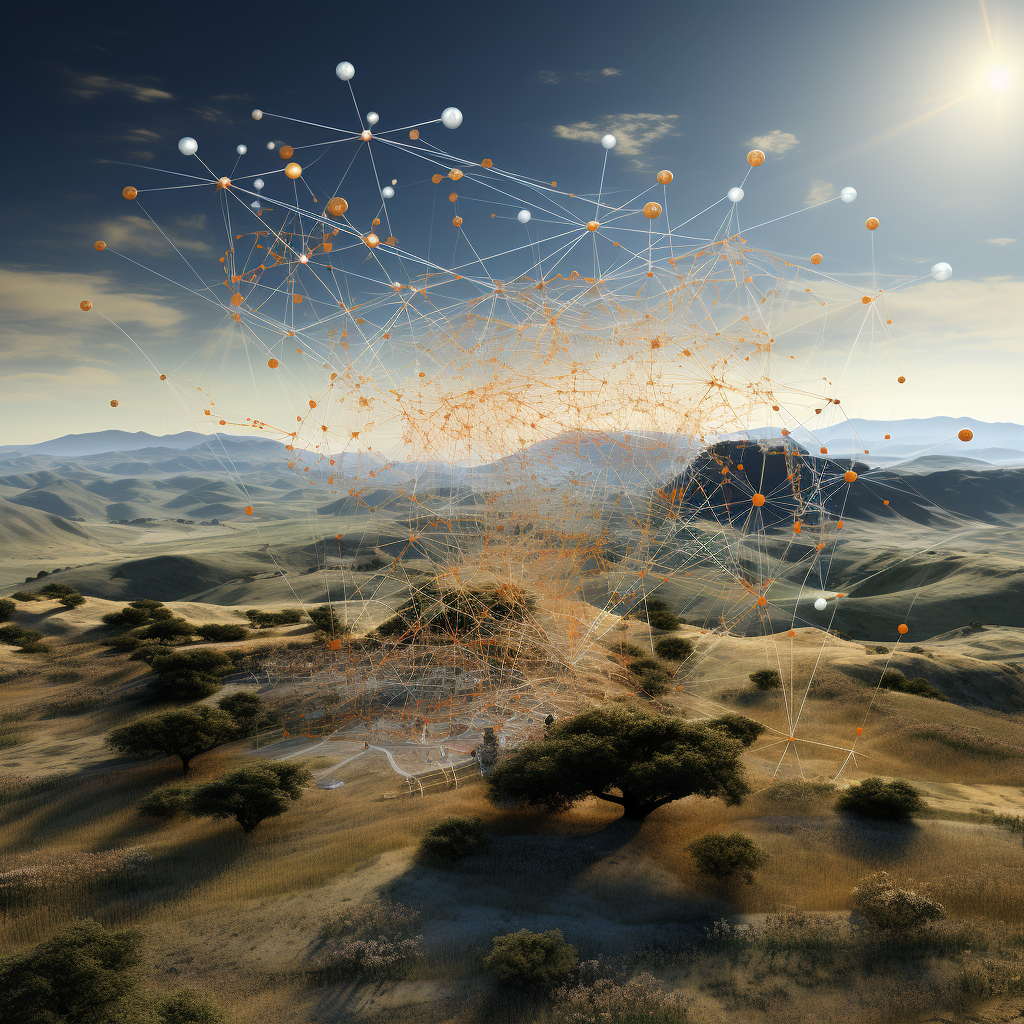
Network Philosophy: Structures and Scholarship (Midjourney)
In the rapidly evolving landscape of learning network design, there’s a critical need to construct networks that are at the same time resilient and adaptable, equitable and accessible, authentically engage the human and more-than-human, and are capable of handling increasingly complex challenges. One response might be the speculative concept of the hybrid ecological network — a living synthesis of principles from material ecology, movement ecology and corridor ecology that allows a reimagining of distributed network design.
Midjourney – movement & material ecology
Material Ecology: Reimagining Nodes
Neri Oxman’s pioneering work in material ecology offers a robust framework for conceptualizing nodes within networks. Each node, akin to a unique material entity in Oxman’s schema, possesses inherent characteristics that enable complex interactions and gives each node a unique material identity (material ontology) that reflects a symbiosis between the human and more-than-human worlds.
Material ecology integrates design and computational biology with traditional fabrication and building processes. It emphasizes the idea that materials are not simply passive substances used to build objects; they participate in the ecological systems in which they’re situated.
If we apply this framework to network design, nodes in the network can be viewed as material entities with their own unique attributes, capabilities, and contexts. Nodes are no longer merely points of connection; instead, they’re akin to unique material entities possessing distinctive characteristics that influence their interactions and behaviour within a network.
In a speculative hybrid ecological network, ‘material’ characteristics could manifest in multiple ways — a node’s ability to process and generate information (its computational capacity), its connectivity to other nodes (its position within the network), or even its resilience in the face of network disruption.
These characteristics aren’t static — just like in Oxman’s articulation of material ecology, they’re continually shaped by their interaction with/in the network environment. A node might develop new ‘material’ characteristics (such as enhanced computational capacity) or lose others (like connectivity) based on its interaction with the rest of the network. This dynamism gives each node a unique material identity or ontology, reflecting the symbiotic relationship between nodes and their network environment.
This perspective enables a more nuanced understanding of networks. By acknowledging the inherent variability and dynamism of nodes, we can design more flexible, resilient networks that can adapt to changing circumstances—much like a natural ecosystem. This outlook resonates with the ethos of material ecology, where the synergy between design, materials, and environment leads to innovative and regenerative solutions.
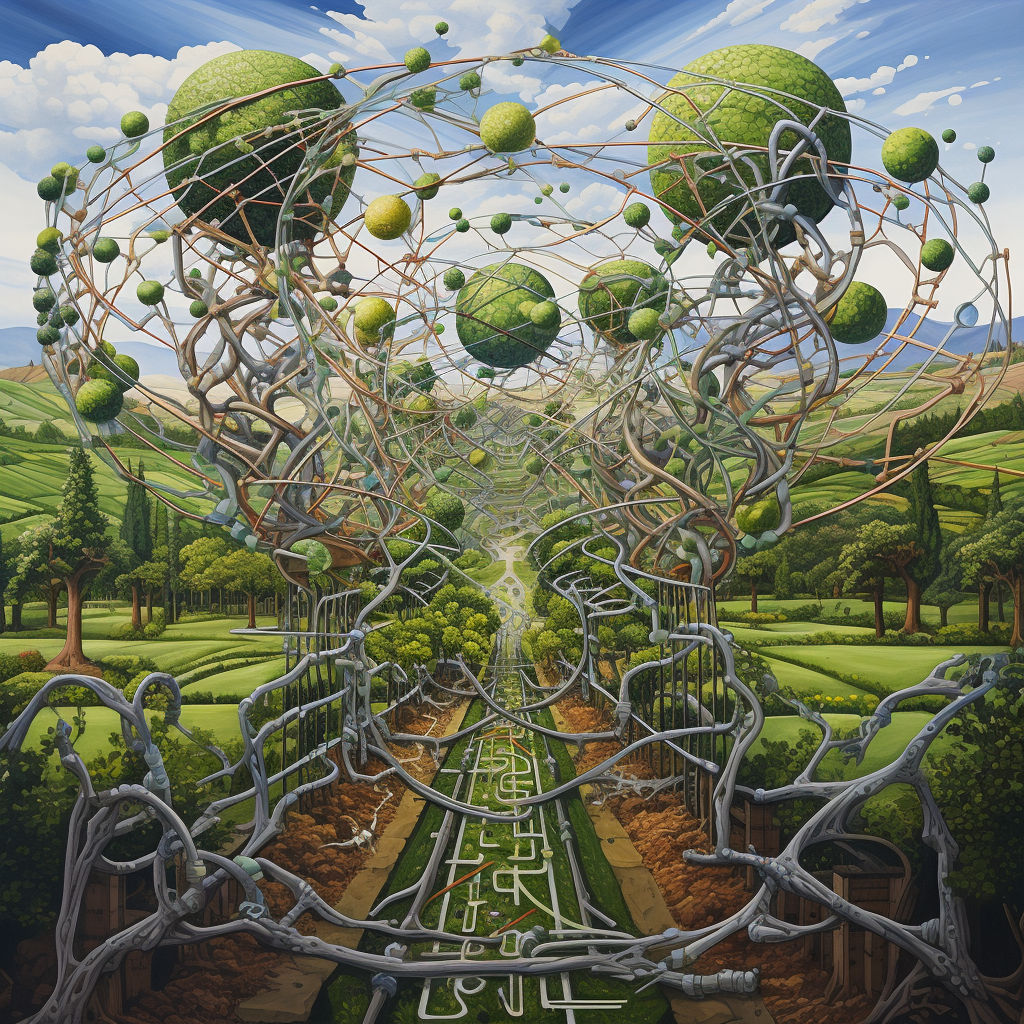
Midjourney – envisioning network flows I
Movement Ecology: (Re)envisioning Network Flows
Thomas Nail’s exploration of movement ecology provides significant insights into understanding network flows. His theoretical perspective portrays information and ideas as migratory entities, subsequently reshaping the way we perceive the traversal of knowledge and ideas within networks.
Nail postulates that society is essentially constituted by movement, with entities (be they people, objects, or ideas) constantly in flux.
Applying Nail’s philosophy to network design, we can reframe the way we conceptualize the flow of information and ideas within networks. Rather than viewing data as static entities being transferred from point A to point B, Nail’s theories encourage us to see information and ideas as migratory entities.
In this paradigm, information (experience, knowledge, skills) moves, evolves, and interacts with the nodes it encounters, akin to how creatures migrate and interact with their environment in natural ecologies. Just as migratory patterns in nature aren’t purely linear but are influenced by various environmental factors and the organisms’ own agency, the traversal of knowledge and ideas within networks isn’t merely dictated by the network structure but is also influenced by the ‘behaviour’ of the information itself and the nodes with which it interacts.
For instance, some pieces of information might ‘migrate’ quickly across the network due to their relevance or urgency, while others might move slowly or even become ‘dormant.’ The nodes that this information encounters can be seen as ‘habitats’ (see corridors, below) that may alter the information, hold onto it temporarily, or help it evolve or develop further.
This dynamic view of network flows allows for a richer understanding of networks. By acknowledging the agency of information (leading to the potential autonomy of data objects) and the impact of nodes on its movement, we can create networks that are more adaptable and effective in facilitating the migration of knowledge and ideas. This conceptualization of networks as motion interweaves with the hybrid ecology view of networks as vibrant, living ecosystems.
Corridor Ecology: Pathways in Networks
Corridor ecology, an interdisciplinary field including biodiversity corridors and landscape linkages, lends principles crucial to designing pathways within networks. The proposed ‘corridors’ enhance inter-node connectivity and encourage diversity, mirroring the facilitation of movement and genetic diversity through biological corridors in nature.
Seeing network pathways as analogous to biodiversity corridors can open our perception of them as dynamic conduits that facilitate the flow of information and interactions, similar to how ecological corridors facilitate species movement. They are not just passive infrastructure but active and vital parts of the network that can adapt and evolve to better serve the network’s needs.
Ecological corridors are essential for connecting fragmented habitats, allowing species to move and interact — often over multiple generations — thereby enhancing biodiversity, resilience and integration with the surrounding environment. Similarly, in a network context, these ‘corridors’ or pathways can connect different nodes — individuals, groups or systems — and allow for steady, organic evolution of connections between nodes that might otherwise remain siloed from one another. They invite the transfer, mixing, and evolution of ideas and knowledge and foster intellectual diversity and innovation.
By designing pathways that facilitate diverse interactions, we can create networks that are not only more cohesive but also more resilient. These networks can better withstand shocks (such as the loss of a node or disruption to network connections) and are more adaptable, capable of evolving based on the needs of their nodes and the environment.
In addition, the concept of corridor ecology introduces the idea of ‘permeability,’ which refers to how conducive a landscape is to species movement. In network design, this would translate to how easily information and ideas can flow through the network. Designing a learning network with high permeability would mean creating pathways that enable the smooth and efficient flow of knowledge and ideas.
By integrating corridor ecology principles, we can transition from a perception of networks as static, rigid structures to an understanding of them as dynamic, adaptable, and resilient systems, much like ecological landscapes themselves.
Midjourney – envisioning network flows II
Computational Gradients
Computational gradients, representing the dynamic spectrum of data processing and learning capabilities, are incorporated into network design. Nodes adapt and evolve flexibly based on their interactions with the environment and other nodes, reinforcing the network’s dynamism. Gradients can represent the varied capacity of different nodes in the network (individuals, institutions, and technologies) to process, generate, and leverage knowledge and information. Some nodes, equipped with a deeper or richer constellation of resources or positioned advantageously within the network, might be situated on a ‘high’ gradient, processing, creating connections and sharing knowledge at a higher rate.
Conversely, nodes on a ‘low’ gradient might have limited access to information or the means to process it effectively. In a rapidly evolving digital society, the position on this gradient is not fixed; nodes can move along it, driven by technological advancements, education, and societal changes. In the context of a hybrid ecological network, capacities are not uniformly distributed but varied across a spectrum or gradient in a network, influenced by multiple social, economic, and technological factors.
Receptive Learning Networks
Incorporating the principles of receptive learning, nodes in the network transition from passive receivers to active learners, which draws from Bruno Latour’s ideas that networks are both constituted by and constitute their components, making them receptive as they respond to the characteristics and behaviours of their components. and other network theorists. This perspective introduces a radical openness wherein nodes absorb, process, and respond to new knowledge, thereby fostering a dynamic learning environment.
Traditionally, networks are seen as conduits for the transfer of information from one node (or point) to another. A receptive learning network proposes a significant shift in this paradigm. Drawing from the principles of receptive learning, nodes within the network are reimagined not as passive receivers but as active learners (akin to material, movement, and corridor ecologies). This shift is transformative, positioning each node as an active participant in the network, contributing to and shaping the information that flows within it. Each node actively contributes to the network, and the ‘shape’ or state of the network is continuously evolving based on the actions and interactions of its nodes.
Receptive learning, in essence, emphasizes the importance of active engagement and receptivity to new knowledge. In the context of networks, this translates to nodes that are capable of not just receiving but absorbing, processing, and responding to new information. This could mean refining or transforming the information based on the node’s unique context or generating completely new information as a result of learning processes.
In the context of a hybrid ecological network, each node—whether an individual, an organization, or an AI system—is continuously learning and adapting. This fosters a dynamic learning environment within the network, allowing it to stay responsive and resilient in the face of new information or changing contexts.
In essence, the network becomes a vibrant, living ecosystem of learning and adaptation, creating a complex, rich, and diverse environment for the generation and flow of knowledge and experience.
Emergence of Hybrid Ecological Networks
The integration of these ecologies invites a radically open framework that yields a speculative approach to network design that engages the complexity, interactivity, and adaptability found in natural ecosystems. This innovative design interweaves the complexities of material ecology, the directed flows of movement ecology, the interconnectedness of corridor ecology, the evolving computational gradients, and the dynamic principles of receptive learning. In this model, each node — whether an individual, an ecosystem, a more-than-human actor, a group, or automated system — actively engages in the learning process. Knowledge transfer thus evolves from a unidirectional process to a continuous cycle of interaction, adaptation, and evolution.
Each node in the network has the capacity itself to become an active participant more than just a passive presence — one capable of engaging with, processing, and responding to new knowledge and new experiences. This dynamicity and adaptability mark a radical departure from traditional, static network designs and open possibilities for the creation of more resilient, adaptable, and effective networks.
Hybrid ecological networks, while theoretical, underscore the potential of new transdisciplinary thinking, demonstrating how insights from diverse fields can converge to innovate upon established paradigms.
Given the escalating complexity of global ecological and social challenges, the demand for more resilient, adaptable, and interconnected learning networks is paramount. While speculative, hybrid ecological networks propose a dynamic revision of network design — one that embraces complexity, cultivates receptiveness, and advocates for continuous adaptation and learning. This transdisciplinary approach insists upon reimagining traditional boundaries, fostering dialogue and collaboration across different areas of expertise and highlighting the potential for innovation.
Framing a learning network as relational (drawing on Bruno Latour) can radically open learning to the complex web of interdependencies that exist across teachers, students, institutions, ecosystems, cultures, experiences, and indeed all parts of a learning network. In the context of practice-led learning, such networks underscore that learning is a shared endeavour grounded in authentic relationship – often through community practice, service, or shared activity inclusive of a full diversity of stakeholders allowing learning to be a cooperative evolving process influenced by multiple actors.
Receptive network ontologies further acknowledge the importance of openness to new ideas and different viewpoints in learning. The synergy between relational and receptive networks empowers learners to actively engage with a range of information sources and build their unique understanding. This shifts learners from passive recipients to active contributors and empowering them to explore, share, interrogate, and critically scrutinise information, practice, and experiences.
The combination of relational and receptive network ontologies offers a potent theoretical structure for understanding and promoting a reimagined learning paradigm that foregrounds relationship, receptivity co-creation and collaboration in an authentically distributed framework. Acknowledging learners’ interconnectedness and their openness to a diversity of knowledge and experience allows the co-creation of inclusive and participatory educational spaces.
Interweaving relational and receptive network ontologies emphasises learners, their agency, interconnectedness, and openness to diverse perspectives. By adopting this perspective, a de-institutionalised learning paradigm – such as a distributed network – can foster an environment that promotes active learning, collaboration, and critical engagement. Specifically, it can empower exploration in the following areas:
Distributed Agency: Agency would be distributed among all nodes – student, teacher, human and more-than-human, treating each as a valid and capable participant. This could translate into a network where participants are not just passive receivers and providers of information, but active participants that engage and shape the network in unique ways. Beyond an emphasis on nodes, the receptivity of such a network would give equal agency to connections and relationships as to objects in relation.
Collaborative Learning: A relational and distributed learning network would emphasize collaborative, experiential, and embodied learning. The network could facilitate interactive experiences, encourage peer-to-peer learning, and even integrate with physical or augmented reality environments to support embodied learning experiences.
Fluid and Dynamic Structures: Such a network would also have a fluid and dynamic structure, reflecting the constant flux and change of ecological complexity. Rather than being fixed and static, the network would continually adapt and evolve in response to the actions and interactions of its participants – human and more-than-human (from Aardvark to Albedo to AI)
Ethical and Inclusive Design: A key element braided together within an authentically de-institutionalised distributed network model is a foundation of ethical, inclusive, accessible and equitable design principles. The network would be designed to inclusively evolve, giving all nodes a voice in shaping network changes, and ensuring that adaptations don’t disadvantage certain groups. New identities that blend definitions of learner, teacher, and co-creator roles would be valued within the network and contribute to a diverse, vibrant learning ecosystem. Any accessible network would also engage in what EF Schumacher described as ‘appropriate technologies’, here in the context of minimal computing to empower ‘students to be their own arbiters of engagement’ (Lee Skallerup Bessette).
Development of new network identities: Finally, such a network (inspired as it is by the work of Karen Barad, Felix Guattari, Bruno Latour, Thomas Nail, Rosi Braidotti, Jussi Parikka and others) would necessarily break down barriers between node and relationship; between human and more-than-human; between learning and experience. A receptive relational network could yield an evolution in network identities, an ‘ecology of practices’ that ‘opens up a world: a world of relations, abstractions, spaces that turn into movements … and it becomes an onto-epistemological framework’ (Parikka).
Inroads into the development of distributed and relational learning are not entirely uncommon; however, engaging with dynamic learning networks in the context of institutional frameworks can prove challenging. Nonetheless, there are huge opportunities for learning in innovative network ecologies if learning is to continue to develop as a meaningful way to engage in the global ecological and social challenges that increasingly come to define this century.
What could higher education look like if we understand and engage with our world as a complex, integrated socioecological system?
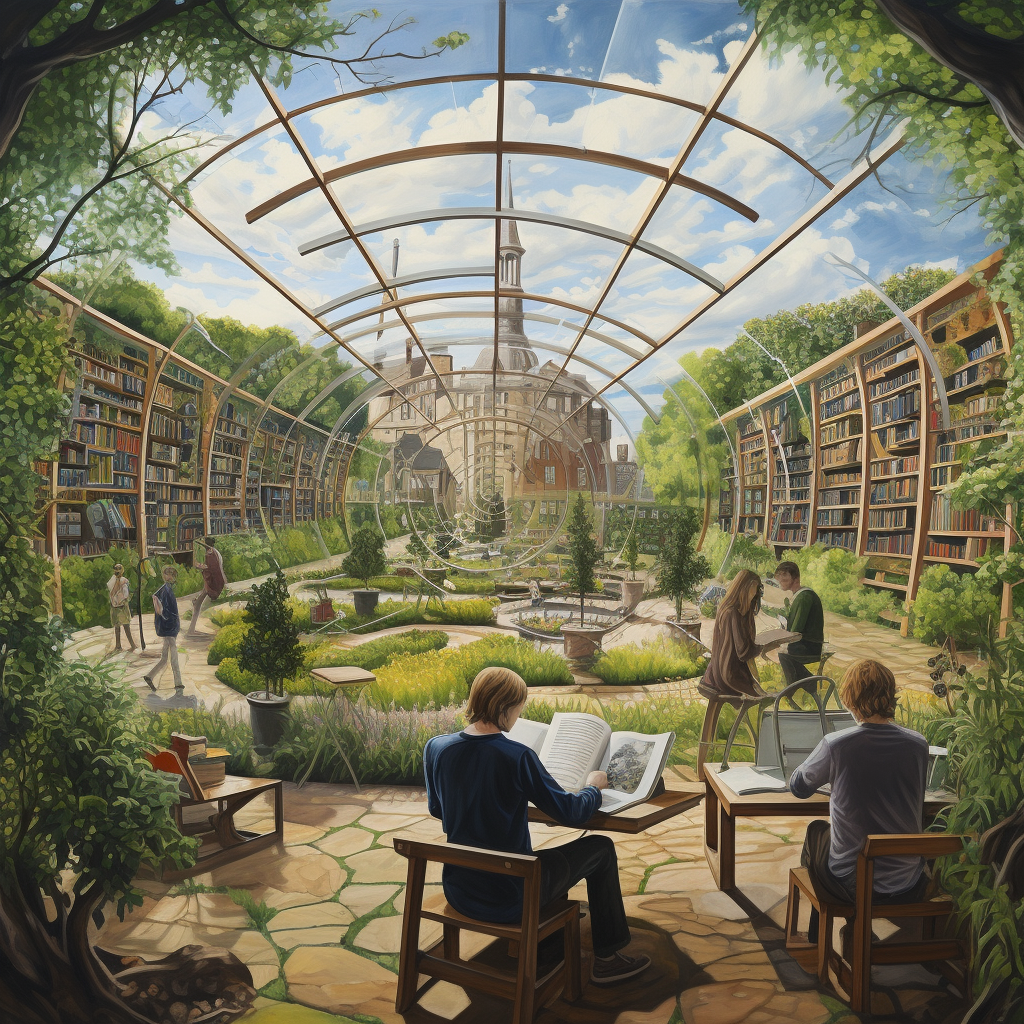
This post outlines both theoretical framework and practical application of resilient learning networks in an ecologically-focused experiential higher education curriculum delivered in a hybrid online and site-based context. An ecosemiotic approach to curriculum design and delivery is introduced that situates humans as deeply enmeshed in a complex sympoietic network.
This multi-scale learning network is always already in the process of co-becoming, manifesting a world in which organisms communicate always in an unfinished processual dynamic.
A globally distributed site-based experience can build a far more resilient learning network than existing site-based, online, or hybrid higher education allows.
Our covid-influenced present and unpredictable future demand radical revision of higher education’s traditional forms of delivery. An ecosemiotic approach to scaffolding distributed site-based learning can help make a pathway toward a resilient, adaptive, and multi-scale curriculum.
a) Development of new network identities and ecologies for interspecies collaboratory spaces
Experiential learning is grounded in interspecies collaboration through enactivist approaches to help learners explore their relationships with the more-than-human world through embodied practice, site-based experience, and participant reflection.
It is essential to support learner understanding and exploration of interweaving network identities — from online learning networks to socioecological networks to local and bioregional networks that underscore the complexity of a multi-sited, multi-temporal, multi-species, and transdisciplinary learning network. Such an understanding must be embedded in the context of programme structure, delivery, and class rhythms.
b) Framing learning in a distributed global learning network (DGLN) in the context of our situatedness within a complex socioecological system
A distributed global leaning network is based on ecological systems and affords learners active co-creative engagement with delivery, projects, and assessments. Attributes include: non-linear dynamics; unpredictability; sympoietic co-organisation.
A globally distributed model integrates a diverse range of site-based experience from different locations in the world and thus creates a rich, complex ecosystem of experience shared across students and engaged with across reflections and formative and summative assessments. In a master’s programme, the breadth of socio-ecological engagement can build a broader, more solid and ultimately more resilient foundation for a final project or dissertation.
c) Deployment of learning clusters of colocated off-site students to enable face-to-face collaboration and experience when travel is not possible
On-site facilitation is key to support learners’ sensual engagement with more-than-human actors that are subsequently shared through both synchronous and asynchronous multi-media. Relationships with global partners able to support and facilitate student experience around the world is a key component to a successful and vibrant DGLN. Indeed, such a network fosters genuine collaborative two-way learning due to the unique nature of global site-based learning. The pedagogy and curricular frame are held online and enriched by a breadth of experience across the different participating sites in an approach that underscores decoloniality through the sharing and application of global ways of knowing and practice.
For example, in a postgraduate module on soil health (MSc Regenerative Farming, Food and Enterprise at Schumacher College), the course would frame theory and research methods whilst drawing on local knowledge, traditions, methods, and understanding of local socioecological networks in sites with very different climates, soil structures, and seasonality.
d) Equitable site-based facilitation of experience-based learning for all students, whether on or off campus
A key challenge for hybrid learning is the ability to provide equitable experience for on and off-site learners. An adaptive and distributed curriculum must be grounded in facilitated site-based experience through a robust learning network.
Typical hybrid or hybrid-flexible learning blends synchronous and asynchronous online learning to support simultaneous learning for students both on-site and off-site. The learning in the majority of settings is centralised and focused on the delivery of information and assessment. In a distributed model, learning is the network (to echo George Siemens’ Connectivism: Learning as Network Creation (2004)), and relationships among students, teachers and the more-than-human world are the foundation for a process-based enactivist approach to collaborative experiential learning.
e) Implementation of Next Generation Digital Learning Environments (NGDLEs) that integrate a self-organised set of tools to complement the use of a VLE or LMS.
NGDLEs comprise a complexity model and empower learners to identify appropriate tools for connecting ecosomatic practice and ecosemiotic engagement. Tools must be simple, student-aligned, and alive. If the development of a suite of online tools adapts to the systems-approach to learning, they can be adapted from simple platforms already used by students and supported by a learning management system (principally only as a platform for delivering content). In a co-created learning network, the tools may evolve and vary based on need, accessibility (including government censorship and bandwidth access).
For more on NGDLEs, visit the research published at Educause by Malcolm Brown, Jeffery Pomerantz, and D. Christopher Broooks. “The NGDLE: We are the Architects” is a good place to start.
Ultimately, an ecosemiotic approach to learning can help build a more regenerative and resilient model for higher education. A regenerative approach continually enfolds, adapts, and participates in complex socio-ecological system dynamics through acts of interspecies listening, co-creation, and collaboration. Further, an understanding of multi-level and large-scale socioecological resilience factors can help learning programmes to build a resilient relationship between human and more-than-human participants.
Maintaining diversity — among learners, tools, experiences, approaches, and means of access to learning
Establish and cultivating connectivity among network participants
Being receptive to feedbacks in an authentically regenerative model
Embracing complex thinking to enable new connections, new collaborations, and innovative ways of thinking that draw on a diversity of models — effectively leveraging a complex socioecological learning network to build new ways of knowing and practice.
Finally, a regenerative learning model — such as those developed at Schumacher College and Dartington Trust — grounded in an ecosemiotic approach that recognises the essential role that the development of place-based knowledge and practice through experience across diverse sites around the world is a key component of the future in the rapidly changing landscape of higher education.
Over the past year, I have been invited to participate in a number of different podcasts and interviews — on topics from endurance running to resilience to global learning networks. Please see the list below and enjoy!
Open Ambient is a soundscape project that employs ambient sound recording, data sonification, photography, GPS, and place-based experience in an exploration of the “Sugarbush” at Sterling College in Craftsbury Common, Vermont.
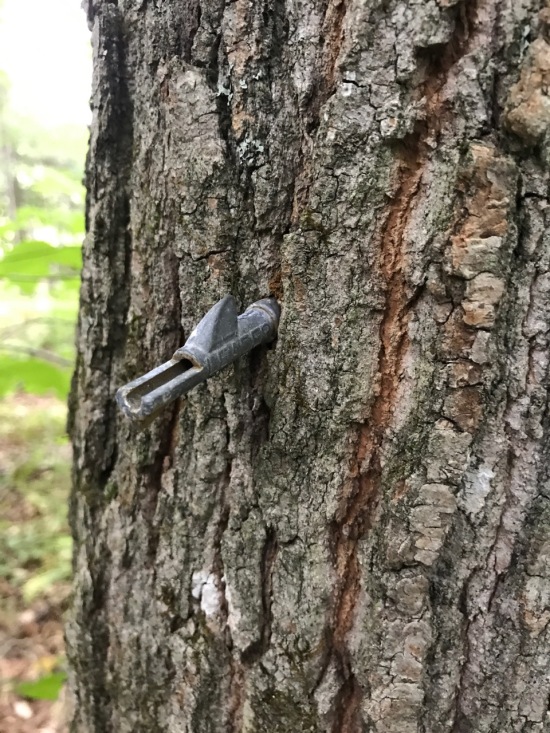
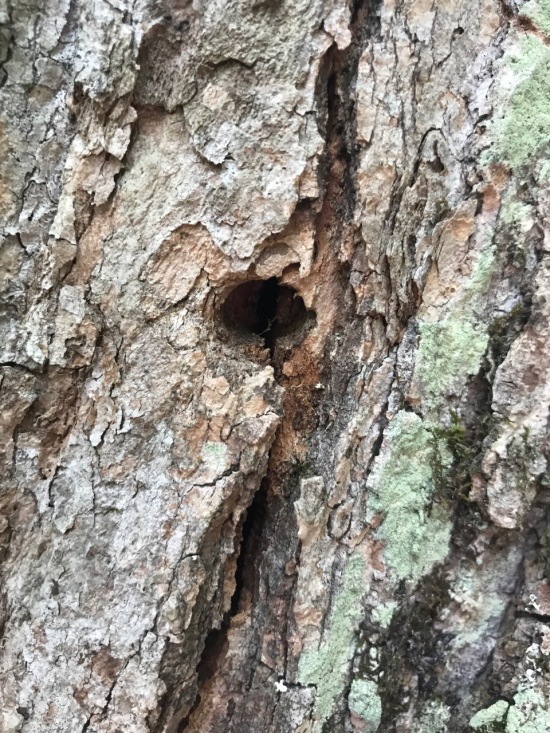
Over the spring, summer, and fall of 2018, I spent many hours in a 10 acre section of mixed hardwood forest that is dominated by more than 100 sugar maple trees, most of which are tapped each spring for their sap, which is then boiled in Sterling College’s sugarhouse to make maple syrup for use in the College kitchen.
One result of my time with the maples is a 4-track playlist of sounds inspired by the relationship between humans, the trees, and climate change.
The four tracks of Open Ambient: Maple Acoustics are a sonic exploration of the potential impacts of climate change on maple syrup production in the Sterling College, VT sugarbush. Data used to drive the music include the 2% ‘typical’ sugar content in sugar maple sap; a projected 20% decrease in sap sugar content by 2100; the 1.6% sugar content projected at the end of the century; and the 40:1 ratio of sap required to syrup produced, which will increase over time given projected warming temperatures. All 4 pieces are overlaid atop ambient sounds from the sugarbush recorded over 2 sessions in summer 2018.
“Open Ambient” is borrowed from the work of philosopher Susanne Langer.













 Ecologies of Knowing