Of Apples, Turbulence, and Hope

“Resistance . . . is not a separate force, but comes from the flow itself, and enables the unfolding of what in it is always potentially there; it precipitates the collapsing of its own potential into the actual” (Iain McGilchrist, The Matter with Things

I picked a basket of apples from our campus at Prescott College today, both as a harvest of memories and of possible futures. 

Every college at which I’ve had the honour of taking a leadership role, we have held an annual apple pressing — harvested in turn from Sterling College’s Vermont hillsides, Schumacher College’s centuries-old trees (mixed as they were amongst medieval quince and ancient medlar trees) in southwestern England, and Prescott College’s more recently cultivated varieties suitable for the higher climate of north-central Arizona. In the 1990s, I was fortunate to work at an apple farm in western Maine. Part of the work there, too, was pressing countless bushels of fallen apples into cider between folded felt and wooden slats with a 19th-century hydraulic press. 

Apples, juice, and cider have for me been a connective flow across bioregions, communities, and continents. At Schumacher, we pressed apples in a wooden barrel press and filled hundreds of bottles with juice to be served with meals throughout the seasons; years later, the flavour of dried fruits mixed with porridge alongside juice bottled by the community the year before lingers in my memory. 

Earlier this month, Prescott College’s own Harvest Festival invited students, staff, families, and friends to share in a meal and cider pressed (often by eager children shepherded by our students) from the trees whose boughs still held unharvested apples just above. 

“May something go always unharvested!
May much stay out of our stated plan” (“Unharvested,” Robert Frost)

When I returned today to pick a few apples for my own family, I left many dozens behind, some still low enough for deer, higher ones for birds and squirrels. My harvesting was part of an ancient ritual, which echoes backwards through shared histories and forward in a dialogue with infinite narratives of possibility. Fermented, or ‘hard’ cider (in the UK, simply ‘cider’) is itself a process of alchemic transformation. Patience, both in the cultivating, grafting, nurturing to fruition — and in the bottling, storing, and fermenting — is critical.

You can’t rush apples. 

“I’ve become a lover of slowness, patience, endurance, and long-term vision, because these things see, like crucial equipment for changing the world or even understanding it” (Rebecca Solnit). 

Picking an apple from a tree is, then, only a small part of a process, the outcome of which can be as infinite as the unexpected flavours of wild apples from trees thickened by animal browse — whether eaten fresh, baked, sauced, juiced, canned, dried, or fermented. As a sometime writer, I can’t help but think about those possibilities when the trees blossom in the springtime, full of stories and promise, and, in cooperation with their stewards, speak to a resilient yet unknowable future.

“Books have plots, because they are finite and authored; the world has an infinite number of authors, of whom you are one, and the surprising outcomes are often due to underestimated agents” (Rebecca Solnit)

This movement and its manifestations, with which I’ve been preoccupied for the better part of a decade, have come to adumbrate the infinite unknowable — whether the apeiron of Anaximander’s world, the vortex of Democritus, Lucretius’s clinamen, or Siddhārtha’s Nirañjanā. The celestial nature of apples left unharvested on the uppermost boughs, dark against the bright Arizona sky, connected as they are to histories and futures alike, invites us to consider, as Thomas Nail writes, “the material conditions for the emergence of things are themselves not things,” or, more pointed still: “Movement is reality itself” (Henri Bergson).

With this in mind, I reach to pick another apple — seeking one not yet split by the heat or prised open by birds or squirrels — both as labour of love and metaphor for the heavy lifting that lies ahead, because, as Audre Lorde writes, “to refuse to participate in the shaping of our future is to give it up. . . . Each of us must find our work and do it.”
Disrupting Fixity: A Path toward Regenerative Practice

Disrupting Fixity: A Path toward Regenerative Practice

Maybe it was the autumn foliage on the verge of turning along the riverbanks and edges of New Hampshire fields, themselves having turned into palettes of ochre and sepia from weeks of late-summer drought — perhaps it was the deepening topography as I drove further north — or likely also it was the late afternoon sun reflecting off the rippling surface of the Pemigewasset River, wider here north of Plymouth, as it makes its way from sources in the White Mountains miles to the north. Whatever the reason, the slightest seed of a Robert Frost poem, like a brilliant white tuft of milkweed on a gossamer wind, made its way into my consciousness. The one line ‘and we lose all manner of pace and fixity in our joys and acquire a listening air’, from his poem ‘The Sound of Trees’ started as a kernel and grew layer by layer to my remembering the whole of the poem by week’s end. 

Pemigewasset River at Livermore Falls

My talk at the Museum of the White Mountains, titled ‘Interwoven Ecologies: Movement and Regeneration in a More-than-Human World’ had Frost’s concept at its very heart — that at our core we are an ‘expression of forces’ of both human and more-than-human worlds, a recognition of a de-centering that can dramatically empower us to engage in the questions of relationality, agency, and more. 

In his context, Frost limned a relationship with trees as sentient and relational beings and brought readers into a receptive mode while acknowledging the movement-centered existence that the trees, while perhaps outwardly sedentary, expressed both to and through us — as co-inhabitants of the poem and the transformative power of human/more-than-human relationality. 

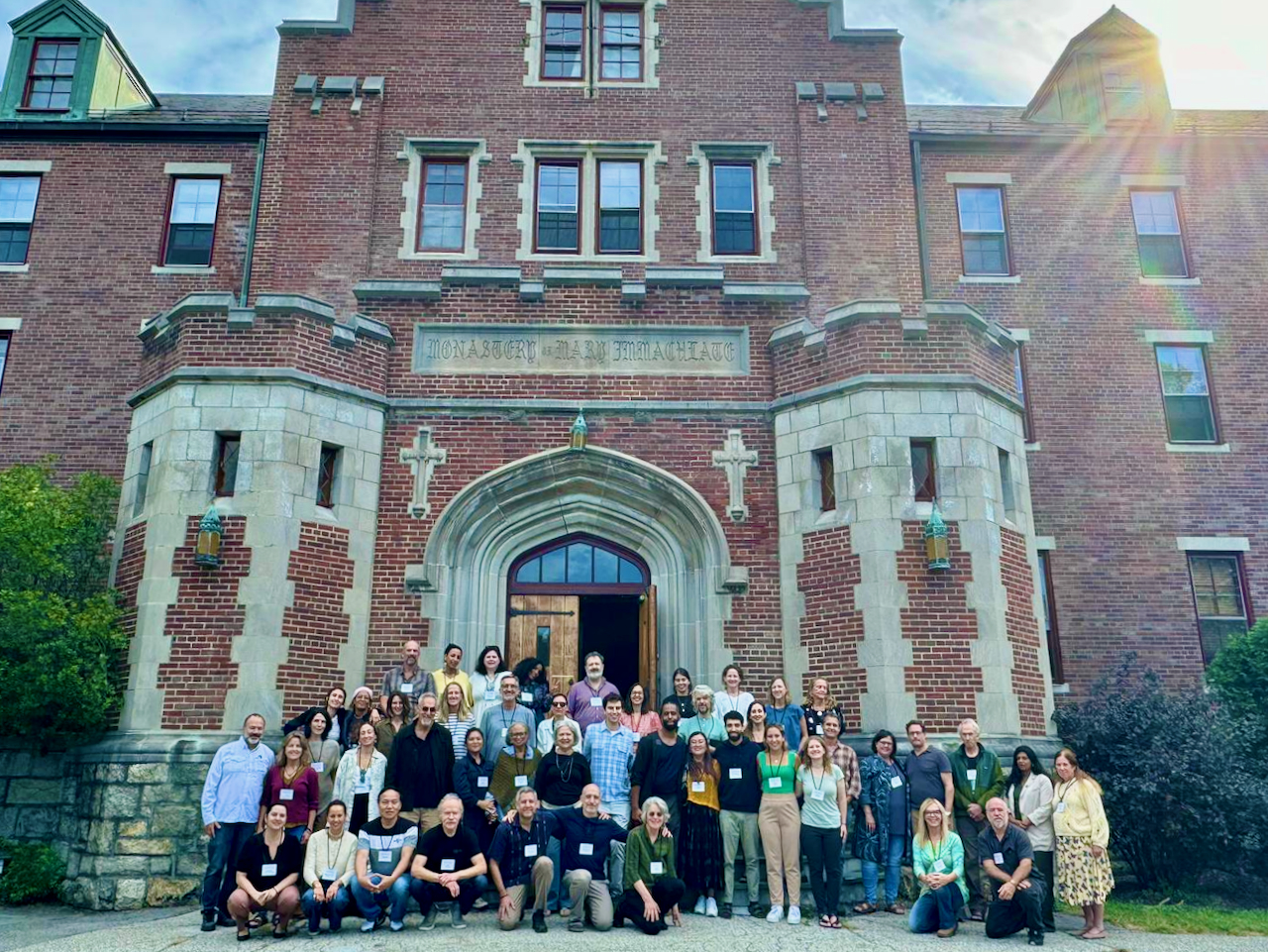
Frost’s poem stayed with me as I shared the second part of the week at the Garrison Institute in New York’s Hudson River Valley with a wonderful group of approximately sixty leaders from all over the world in conscious food systems, planetary health, regenerative learning, agriculture, consciousness studies, funding, global networking, climate change activism, indigenous ways of knowing, and more — from academia, yes, but largely from practitioners and the non-profit and advocacy sector — to explore how the implementation of consciousness and regenerative practices can help transform food systems at scale. 

The Garrison Institute

The questions that surfaced & ideas we shared in our three days at Garrison resonated with my reading of Frost’s poem earlier in the week, and his words kept creeping into the margins of my notes as we shared initiatives on regenerative practice as a ‘process of rebuilding and renewal of the common ground from crisis and collapse to regeneration and renewal’ (Hannah) in the hope that we can reshape and ‘affect value changes and lead to deeper conscious change’ (Andrew) in a reimagination of a range of practices, including an educational framework inviting learners and communities of practice to counter a prevailing exploitative growth-minded outlook and ultimately asking, ‘why are the questions what they are? — and why are the research methodologies shaped the way they are?’ (Nicole)

There were so many layered conversations that engaged with/in the full spaciousness of the former Capuchin Monastery on the banks of the Hudson that it may take months to see how some of the newly spun threads of inquiry will find one another to weave into a more conscious and holistic future for both food systems and broader regenerativeness into which I hope we can see them evolve. Despite the fertility and depth of conversation, and the spaciousness and time, there was an underlying urgency as we sought to find the leverage points where these seeds of radical growth could find fertile soil in which to flourish.

At the same time, I was reading Marica Bjornerud’s wonderful Timefulness, which, with a deep understanding of geomorphology in the context of a contemporary worldview that ‘represents an “epistemic rupture so radical that nothing of the past survives”‘ (161). To help us unmoor from the ‘Island of now’ and destabilize our fixation on the present, Bjornerud invites us to collectively find a way ‘how to turn rocks into verbs’ (61) in order to recognize our own temporal geopositionality in the context of a prevailing seismodynamic and tectonokinetic fluidity.

Bjornerud’s lithico-philosophical sedimentations couldn’t help but send me to my bookshelf seeking my well worn and now fifteen-years’ old reading of Stones of Aran, to find where Tim Robinson similarly asks, ‘what tense must I use to comprehend memories, memories of memories of what is forgotten, words that once held memories but are now just words?’ (8). Exceptional details of the Aran Islands percolate upwards through the karst landscape to momentarily coalesce in turloughs, ‘letting the island recompose itself as music’ through the fluidity of its seasonal movements — ‘Il cimento dell’armonia e dell’inventione’ forever cast and recast along this unmoored archipelago in the North Atlantic.

Farther west still and even farther north, on ᐅᒥᖕᒪᒃ ᓄᓇ, Umingmak Nuna, Land of the Muskox (also known as Ellesmere Island) in northern Nunavut, Robert Frost’s un-fixity leads me (during my long drive back from the Hudson to Boston for my flight home) to Aritha van Herk’s exercise in un-reading along the shores of Lake Hazen, well above the Arctic Circle at some 81°N. As she seeks to reclaim the eponymous character from her well-worn copy of Anna Karenina to ‘free her from her written self’(119) on the remote island that does not permit ‘such bare-faced superficiality’ (94) ‘within this endless light [where] she resists all earlier reading’ (121). For centuries, the far north has itself been written into the psyche of so many in the south as a fixed imaginary (a place, an idea, a feeling, a place of both possibility and fear), so a critical un-reading of a fiction in the reality of an all-too-often mythologized place seeks (not unproblematically, certainly) to re-situate, re-name, de-colonize fictionalized bodies and terrain. It’s much as Alootook Ipellie underscores in his Arctic Dreams and Nightmares, ‘The Arctic is a world unto its own where events are imagined yet real and true to live, as we experience them unfolding each day’ (xix).

Summer in the Scandinavian Arctic

Van Herk takes her tack with the wind flowing through Frost’s trees upon the waters rising and falling in Robinson’s turloughs as she un-reads and re-writes self, text, and terrain in a kind of reclamation—a way of freeing bodies and places from a framework of imposed, static, and ultimately marginalizing static narratives.

This work of unsettling static narratives, then—whether of bodies, language, places, or time—reveals the movement inherent at the heart of both human and more-than-human worlds. A resistance to fixity allows us to see the networks of interconnected movements that define us: wind through the trees, seasonal flux of water across landscapes, words within a narrative and the shifting contours that limn our collective and individual understandings. Much as we engaged in practice and conversation at the Garrison retreat last month, where we explored the intersections of consciousness, transformative food systems, and planetary health, this disruption of imposed frameworks encourages a deeper engagement with complexity and relationality. By un-reading and re-imagining these static frameworks (literary, human, and ecological alike), we open pathways for radical, root-deep transformations.

In embracing this dynamism, we re-inhabit these spaces, liberating not only the land and its stories but also ourselves. We are reminded that regeneration—of ecosystems, food systems, education, and consciousness—requires a willingness to disrupt and reshape what has been fixed, opening new possibilities for agency, interdependence, and renewal. Disrupting fixity is not just an intellectual pursuit, but a lived practice, grounding us in the work of reimagining and regenerating our shared futures.

The Hudson River