A Relational Poetics

Unde aether sidera pascit?From where would the sky feed the stars?
Lucretius

When language itself comes under threat—narrowed by external constraints or stripped of its generative power—a (re)turn to poetics becomes an act of relational resistance. A poetics of relationality emerges as a living collaboratory between time, place, and self, leading from reflection to becoming to action. For me, this lexical path first surfaced in the moss-soft forests of Himmelbjerget in Denmark, where nature, art, and spirit dance together—from the roots of Danish democracy to Heimdall’s home, to the vibrancy of Himmelbjerggården.

Himmelbjerggården

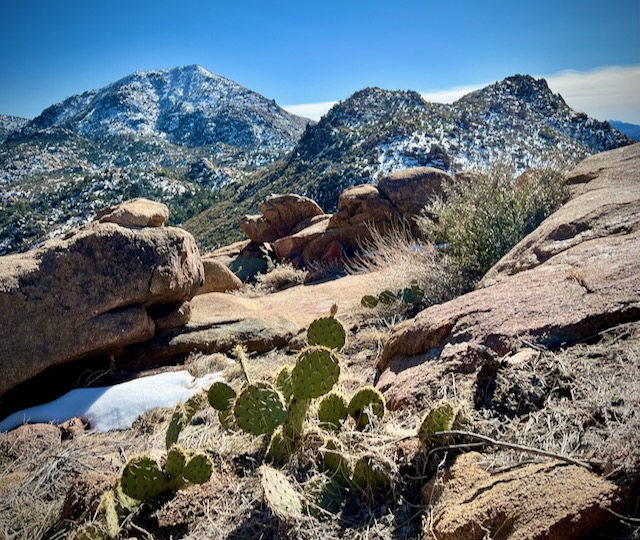
It continued in the chaparral woodlands near my home in Arizona, where manzanita, oak, and the occasional alligator juniper stand as sentinels. There, among their interwoven forms, I found both solace and provocation in the shifting colours of emergent spring. I reached toward what I know: those rare and intimate moments when the human and more-than-human entwine in shared presence.

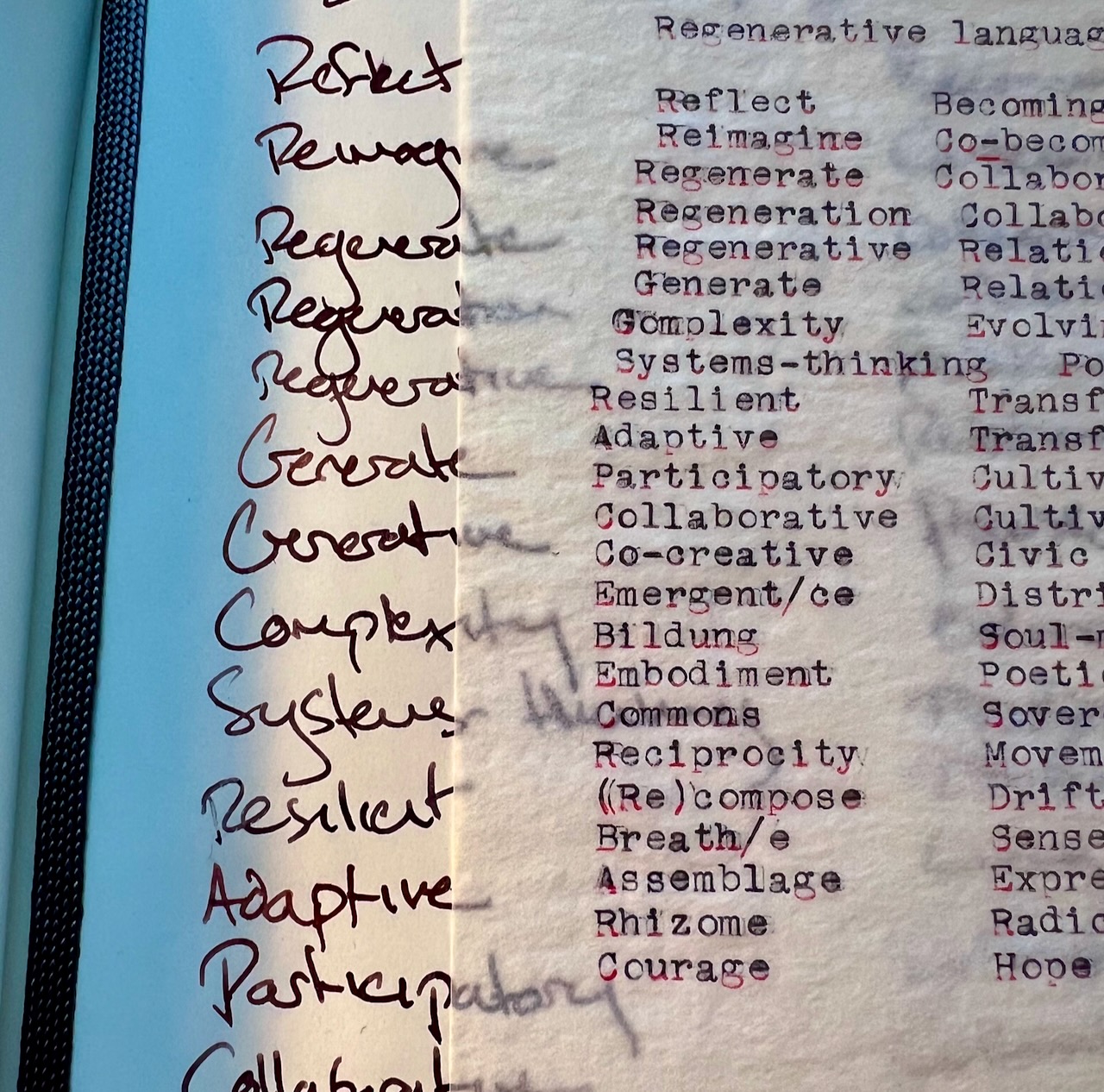
This is a day for calligraphies and choreographies of possibility, where language doesn’t describe the world but co-creates it. From manzanita-infused ink teasing radicles of meaning through translucent typing paper to laptop, the layered materiality of inscription imbues these words with generative power.
I find grounding in the stillness Thomas Merton names, where the mountain is SEEN only after one consents to the impossible paradox: it is and is not. And then—another opening:

“The ‘new consciousness’ reading the calligraphy of snow and rock from the air. A sign of snow on a mountainside as if my ancestors were hailing me… we burst into secrets.”

This new consciousness is not about transcendence but rather about intimacy: an embodiment across place, self, and more-than-human life. It is not language as mastery, but as invitation. The following lexicon is offered in that spirit—an incomplete, living gesture toward what might yet emerge when we let meaning root, drift, and move with the world.

ReflectBecomingDecentralisedApeiron
ReimagineCo-becomingEcologicalExpression
RegenerateCollaborateReciprocityExpressive
Regeneration                  Collaboratory                 Democracy                     Synnoesis/noetic
Regenerative                  Relational Flourishing  Dialogic
GenerateRelationalityFlourish Interspecies
Complexity Evolving  Self-organising              Unfixed
Systems-thinking           PoeticAutopoiesisTotality
ResilientTransformativeLearningSynesthetic
AdaptiveTransformSympoiesisContemplative
ParticipatoryCultivatingPlanetary HealthHolistic
CollaborativeCultivationInterconnectednessIntegrity
Co-creativeCivic engagement ExperientialPoetic-knowing
Emergent / EmergenceDistributedTransdisciplinaryRelational grace
Soul-makingSahajCompostingBildung
EmbodimenntPoeticSpirit / Spiritual / ityInner radiance
ArtCommonsSovereigntyCraft
MobilityFlowReciprocityMovement
(Re)composeDriftKinesisAwareness
Breath / BreatheSense / SensationCirculate / CirculationAssembly
AssemblageExpressionActionSomatic
DeterritorialisationTactileRhizomeRadical
CourageHopeInviteBecome

                                                                                                                    
l’amor che move il sole a l’atter stelle.

the love that moves the sun and other stars.

Dante Alighieri

A confluence of learning

As part of our transition from England to Arizona as I begin my new role of Academic Dean at Prescott College, I was fortunate to spend some time on trails around Prescott earlier this month, taking some tentative steps in these new mountains of home – up into the deeper snow atop Granite Mountain and along the switchbacks up the side of Thumb Butte just west of town — and farther afield to the Colorado River nestled deep in the February shadows of the Grand Canyon. 

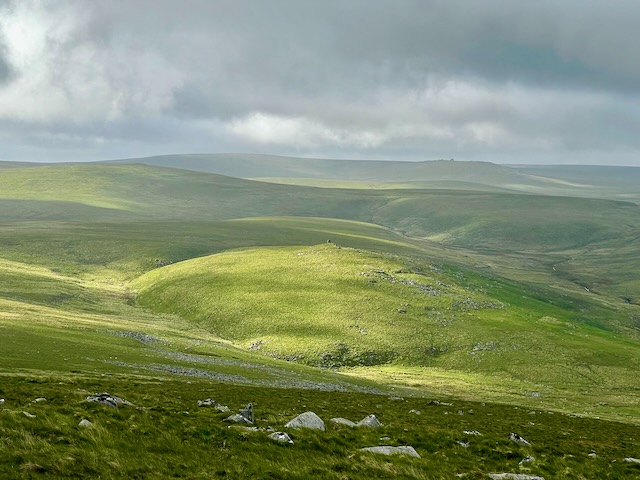
The landscape and climate around Prescott could hardly be more different from our home in the southwest of England, where we are only now emerging from a mild and wet winter, with the River Exe washing over our riverside path nearly every day in the past fortnight. Although I describe Arizona as being ‘nearly the opposite’ of my beloved landscapes from Dartmoor to Cornwall to southern Wales, there is a shared openness in the undulations of this leavened land — here punctuated year-round by brilliant yellow plashes of prickly gorse, there of prickly pear — where I can become lost enough to find myself in ways that nourish head, heart and hands. 

Thomas Merton tells us, ‘action is the stream, and contemplation is the spring’. We each have our entry to moments and places that balance contemplation and action, and over the past four years, Dartmoor has been mine — often finding me ankle-deep in bogs that coalesce to headwaters of one of the more than two dozen rivers that rise high on the moor. It’s hard to relinquish a place that so quickly so deeply permeated my skin and muscle and bone — but having been to nearly every corner of Dartmoor, the headwaters of many river, and well more than two hundred tors, I’m ready to trade these brilliant waterlogged greens for whatever comes next. 

In the hills to the west of Prescott ten days ago, my pace slowed and my breathing and heart rate climbed as I tried to get used to the elevation on the switchbacks above Blair Pass (around 2000 metres), passages from books I’d read years before slowly started to seep in at the edges of my senses. Anne Zwinger, Leslie Marmon Silko, Mary Austin, Colin Fletcher, Gloria Anzaldúa, Gretel Ehrlich, Terry Tempest Williams, and so many more. The place and pace opened my literary memory the way a hint of a smell can so readily transport us back to childhood. The largely open chaparral landscape with a few fire-scarred pinion pine here was drawing me both upward and into myself.

Terry Tempest Williams’ triptych, The Open Space of Democracy, has, with Gretel Erlich’s Solace of Open Spaces, long been a touchstone for my engagement with changing ecologies and the human communities that make their home within them. Williams’ opening essay, ‘Commencement,’ is a transcription of her graduation address at the University of Utah in 2003. With the shadow of September 11, 2001 then an inconceivably heavy weight upon so many, she asks ‘What does the open space of democracy look like?’ and offers, 

‘In the open space of democracy, the health of the environment is seen as the wealth of our communities. 

In the open space of democracy, beauty is not optional, but essential to our survival as a species. And technology is not rendered at the expense of life, but developed out of a reverence for life. 

The open space of democracy is a landscape that encourages diversity and discourages conformity. 

Democracy can also be messy and chaotic. It requires patience and persistence.

Democracy is an insecure landscape.’

Landscapes are always in flux, adaptable, and resilient, and unreservedly open to the world, as democracies must also be. Although I often find the solace of inner spaces seductive — the close focus, isolation and quiet a welcome respite from a fraught world, I’ve found more recently that letting go is also core to building resilience and can open to a sweeping outward spiral from contemplation to action — from spring to stream to sea — and invite a confluence of worlds to deeply enrich my own.

In recent years and with increasing urgency, I’ve taken these embodied moments, where inner and outer ecologies interweave, to build a framework for a similar adaptability and openness in learning, where practice-led, ecologically-focused and community-grounded learning serve as the foundation of education that is regenerative, democratic, accessible, distributed and deinstitutionalised. As Benjamin Freud has recently and succinctly put it, at its core, ‘Regeneration is about becoming with the world, it is about understanding that we are not separate from the world, entangled with every particle in the universe’. There are rich stories of regeneration everywhere to guide us; perhaps we just need to (re)learn how to listen to them.

Along her journey from Wyoming snowfields to the confluence with the Colorado, Ann Zwinger writes the layered ecologies and histories of the Green River into herself, seeing its meandering like lizard prints ‘calligraph the sand, precise patterns laid in loose, open arcs’. Even in the depths of the Desolation Canyon, openness prevails in each meandering arc and blossoms into invitation — to place, to self, to history, to time. Upstream from Zwinger, Gretel Ehrlich finds in the hardscrabble wind-swept beauty of Wyoming’s ranch country, ‘Everything in nature invites us constantly to be what we are. We are often like rivers: careless and forceful, timid and dangerous, lucid and muddied, eddying, gleaming, still’. 

In my soon-to-be-published chapter in One Day in 2050: Clima Utopyas, I point toward an aspirational future, where systems and networks have opened across difference, and ‘The narrative of ‘I’ had yielded to the symphony of ‘we’, an all-encompassing paean of life sharing our radiant globe. ‘Ecology’ had faded, supplanted by ‘unity’, ‘harmony’, ‘symbiosis’ . . . [and]  humans were no longer mere observers but engaged participants, active choreographers in the always emergent dance of life, finally at home.’ 

As I step into this new chapter of ground truthing, commencement and engagement, rather than drawing a recursive, circular path, I am more than ever part of an outward-unfurling spiral, with open heart, open arms, and open mind.

Here are your waters and your watering place.

Drink and be whole again beyond confusion.

Robert Frost, Directive

Of Lichens and Learning

‘Sometimes,’ I shared recently with followers on Twitter and Facebook, ‘the answers are in a book about lichens.’

Deep among the vivid pages of Lichens of North America, someplace between the descriptions of Cladina sterllaris and Cladonia cervicornis verticillata, I may have found the inspiration that I’d been seeking.  The glory of lichenate minutiae, the intricate interstices and curls of lace disappearing into fractal edges–It just isn’t possible to get close enough.

Somewhere among these images is what I am looking for.

To liberally paraphrase Karen Barad from her recent book, Meeting the Universe Halfway, the material conditions of much of our current postsecondary landscape “performatively produces” and reinscribes pedagogies and curricula that persist in sketching boundaries between learning and the world beyond the academy. Reminiscent of Tim Cresswell’s notion that we continually practice and re-inscribe ideologies through our daily practice (how do we know how to act in public spaces–how do we conversely recreate those places through our actions?), such reasoning etches parallel furrows in a granite landscape resolutely lichenate.

As educators, we follow, as a matter of course, such glacial scarring on a panoply of metaphoric stones, through or past, but rarely insinuated with the organic systems that surround us.

What would it be like, I asked students in my first-year Writing and Speaking to the Issues class recently, to jump these lines and devote all one’s life to a single passion and a single aim — and one that steps beyond the mere self-serving to change the ways that others think about the world.

If we choose, as I enjoined my students, to engage in dialogue with moments of the performative everyday, what I hope that may well emerge from the complexity of countless nodes and intersections–imbricated and involuted all–is a dynamic system that yields and demonstrates resilience.

So…how to begin?

I’ll see how the students answer that…tomorrow.

on small data

Maybe it will help to start small.

In the entirety of his poem, De Rerum NaturaOn the Nature of Things, as Lucretius advocates for Epicurus’ atomistic view of the world (and thus, now famously through Stephen Greenblatt’s recent book, helps to precipitate the Renaissance), Lucretius only uses the Latin word, datum, a single time–and then only as extrapolated by later readers from a section of missing text.

It strikes me as a bit odd that the term–from dare, to give, and refers to that which is given, present, extant–occurs only once in a treatise devoted largely to ideas about relationships among elements at the atomic scale. Throughout the text, Lucretius seeks exactly this–the unseen datum–something elemental or essential about which one could make assumptions and which could explain the underpinnings of the universe. No small task.

Today, however, our post-theory scholarly landscape reminds us of the continual subversion of any such underlying or essential truth, which leads almost inevitably to some significantly larger questions:

What is given?

What are the essential constituent parts of our inquiry process?

At this weekend’s THATCamp, a group of us interrogated the very idea of data in a session aptly titled “What is the Opposite of Big Data?” With guidance from Suzanne Fischer and Sarah Werner, we made a few tentative steps into the shallow lake of big data looking for some substantive ideational rafts among the flotsam of small data sets.

Two questions that came from our session that might foster some useful research or inquiry:

1) Do humanistic projects need to meet expectations about accuracy and statistical significance? And, how can scholarship that engages a sample size of n≈1  demonstrate its validity and relevance in an increasingly scientific discourse?

 2) Are big data approaches that advocate a distance-reading to large swaths of text or cultural artifacts in some way a response to continual challenges to the relevance of humanities in society broadly? And if so, how can small-data approaches be leveraged to demonstrate the relevance of humanities-based scholarship and liberal arts education generally?
One model around which we coalesced proposes to turn the traditional big data approach (one scholar, lots of texts) on its head (one text, lots of scholars) to underscore the utility of what are, frankly, some really cool DH tools to explore the materiality of texts and artifacts. By having a range of scholars converge on a small data set (be it a single book, poem, musical refrain, painting, or material object), we can turn attention to the affective response inherent in scholarship and create a network of nuanced meanings in the context of a very narrow slice of data. In such a model, the experience of reading itself becomes the data.

Suzanne succinctly summarized the discussion with what began to approach a mission statement–that as a group, “we do value the small and limited, and we do value modest claims. We believe that big data should try to make more modest claims and to think how humanistic inquiry can be ported over to those claims.”

I was left with a something not quite a manifesto and call for a renewed attention to the experience of reading, to the materiality of texts in an effort to reground and make relevant our teaching and scholarship.

Although I think we’d all admit to only being ankle-deep in this discussion, I think there’s also a lot of much more profound terrain to explore. In particular, trending toward small data can continue to decentralize, destabilize, and complicate humanistic study in ways that can (perhaps even more so when paired with contextualizing swaths of big data) open doors to innovative methods of inquiry that foreground the significance of humanities scholarship.

Integrative Studies and Complex Systems

I have been involved in several conversations in the past week related to cross-disciplinary scholarship. Some online, including “Lit vs. Comm”collected by @adelinekoh, and some at the College as we continue to try to articulate the most effective capstone experience for our undergraduate seniors.

As an academic administrator and professor at one of the smallest liberal arts colleges in the U.S., I am perhaps uniquely positioned to support both curricular and institutional initiatives that cross disciplinary boundaries. We are fortunate to have no defined departments, to meet as a whole faculty twice monthly, and to have fully half of our students designing their own majors, many of which capitalize on the breadth of institutional expertise rather than in a narrow and focused research area. Clearly, this kind of undergraduate liberal arts education is only one piece of the post-secondary system, but I think it’s an essential one–and one that could serve as something of a model.

In, Complexity as Practice: A Reflection on the Creative Outcomes of a Sustained Engagement with Complexity (in the most recent issue of Leonardo), Tom Davis introduces complex systems as

resistant to reductive analysis; an examination of a single entity in isolation does not reveal the true nature of its role in the construction of the whole. Complex systems support a worldview very different from that proposed by the reductive Newtonian theories of classical science. In contrast, they offer a more holistic view of the world, a world containing systems that can create new structures and forms on an epistemic or even an ontological basis. They possess the ability to outperform their designers, promise the allure of perpetual novelty and can possibly be deemed creative entities in their own right.

Complex systems, then, are themselves a performative act; if they are irreducible, continually dynamic and developing new structures, then they are similarly generative and effectively greater than the sum of their parts (the “room” that is smarter than the people in it).

A university or college is just such a complex system.

Nearly all of the tools and frameworks that are used to articulate links between technology and learning–  Open Courseware / Open Educational ResourcesNetworked Learning, Collaborative Learning, Hybrid Learning, etc.–underscore the rich collaborative, integrative possibilities of cross-disciplinary scholarship and teaching.

This aspirational rhetoric (as is, I will readily admit, ecologies of knowledge) gives us–and often enacts, to be sure–many models of integrative learning and scholarship whose champions nonetheless continue to negotiate with more traditional institutional infrastructures. Part of the evolutionary process in which many scholars (and many academic publishers) are in the midst of continues to draw attention to the still extant, long-standing concepts of academic disciplines and intra-institutional divisions.

Over the past decade, I’ve organized several conferences whose main purpose has been to take a broad interdisciplinary look at intersections of people and place. From such a regional studies perspective, there is no other way to look at scholarship except from an integrative perspective. When biologists, artists, literary theorists, ecocritics, historians, economists, and ecologists all get together to talk about place, the result is nearly always wonderful…and sometimes revolutionary.

I believe that more coordinated integrative conversations and projects in which we can actively take part, the more we will be able to recognize that the complex knowledge systems in which we work can empower entirely new modes of thinking and learning.

digital pedagogy and the experience of close reading

As the sun finally comes out on this last afternoon of the 2012 Digital Humanities Summer Institute and settles in pools in this quiet corner of the UVic library, I’m tempted to try and reflect on everything I’ve learned and all the questions that have been raised for me this week.

No doubt that process will take a (very) long time, yet one highlight (among many) from the Digital Pedagogy sessions at this week’s DHSI was from Jentery Sayers‘ presentation on the relationship between process and product in DH pedagogy. On the second day of our week-long class, Jentery used Google Maps as an analogy to situate us in a moment of “constant juxtaposition of the street level and the global view.”

As anyone with even cursory experience with Google’s mapping apps is aware, the ability to scale from global to intimate scale is not only a powerful learning tool, but also a tool that frames–divides, unifies, and layers different contexts upon–our world in a very particular way.

It’s also, let’s face it, an awful lot of fun to zoom around landmarks, distinctive landscapes, and the neighbourhood your grew up in.

Absolutely.

Yet…

What happens to the place itself, which now only exists in this spectrum of representations?

Similarly to Ursula Heise and Bill McKibben’s appropriation of a highly technologised view of Earth from the 1972 Apollo 17 mission as an image of a unified “blue marble,” the appeal to spatial representation in not without its problems: The proliferation of affective markers (the sentimental photograph of a particularly beautiful sunset or rainbow or alpine meadow) enabled by material culture (images taken by devices, uploaded to servers, imbricated with code, and represented on still other devices) most frequently underscores the movement through space rather than connection to particular places (Picasa images of people’s vacation highlights, Google Map flyovers, narrative sidebar directions, and so on).

If we do (and I think we do) suffer from “a general failure to blend the distant with the close” (Jentery again), then what approaches do we need to take (as humanities scholars) in order to layer the close and the distant in a more nuanced and intentional way?

With regard to close reading and textual analysis, for instance, we found that myriad tools exist to parse the occurrence of terms or concepts in a text, yet far fewer are available to drill down into the contexts, etymologies, and ambiguities of meaning in individual sentences and words.

Although I made an attempt at a DH-inflected assignment that asks students to use close reading of a passage as an entry to larger analytical and written projects (zipped Prezi available here through the course’s webpage), it’s just a first stab at a much larger issue–how can DH pedagogical approaches help us to ground student scholarship in first-hand experience with primary materials? Encoding text, annotating sentences, parsing paragraphs for word frequency–all of these are valuable approaches, which, if used carefully, can bring our students to textual analysis as a fundamental building block of humanities scholarship.

Attention to the labour of reading and the experience of the text can only enrich the connections scholars can make by looking at these narrower street views in the context of an ever-evolving map of the world.

on deep literature, place, and action

I was prompted to re-read parts of Jean Francois Lyotard’s The Differend: Phrases in Dispute last night, and I realized that, in many ways, he gets at much of what’s been troubling me about the place of language in humanities…as well as what has been influencing me on the road through online collaboration, open educational resources, open courseware, distributed learning, and an exploration the potential of Digital Environmental Humanities approaches to curriculum design and student learning.

Though by now fairly well-trodden territory, I am drawn back to  The Differend because, among the discussions of anitstrophon and litigative impasse, Lyotard reaches time and again for his lexical touchstone:

The differend is the unstable state and instant of language wherein something which must be able to put into phrases cannot yet be.

This resolutely post-semiotic turn urges us to look at experience and events and ideas that language simply cannot (yet?) address. I eagerly follow Digital Humanities discussions that suggest tools to help get us toward that goal.

Lyotard reminded me, too, of Ted Nelson‘s early, innovative (yet ultimately implementationally-challenged) concept of a Deep Literature and a breaking down of boundaries between individual web pages and files. Nelson’s premise for the now dormant Xanadu project was to question why the World Wide Web is based on discrete pages and documents when the technology could yield a more seamless and fluid knowledge environment. The systems and interconnections among different pages, each of which effectively acts as its own signifier, remain more-or-less linear as users are compelled to move from one ‘page’ to another.

The proliferation of  network visualizations–and the development of the Semantic Web–are steps toward Nelson’s ideal, yet only as a meta-construct–a mapping of interrelationships among pages, which, despite their now content-driven (rather than originally form-constrained) architecture, remain only a few layers deep.

We are driving toward, it seems–in post-semiotic representations of concepts, ideas, interpretations, literature beyond textuality, and other creative endeavors–a way to represent pages and places and ideas *without* the constraint of what is still a text-based and relatively static form.

Much of this thinking continues to lead me to question whether (and how) it may be possible for writing and action to co-exist in the same moment or place.

Reading Jentery Sayers’s post on Making Things in the Digital Humanities helped to frame this question in terms of an almost Thoreauvian drive toward immersive experience:

To be sure, critical distance is necessary in order to consider multiple perspectives, replicate methods, and produce abstractions (e.g., prototypes, diagrams, and maps). Yet we need immersion, too. Call it play. Or tinkering. Or hands-on learning, if you wish. It’s all serious. It’s also no more immediate, or authentic, or legitimate than its abstract counterparts. Rather, it’s one modality among many.

The experiential education model that frames our College’s curriculum attempts to balance writing and action, yet almost by nature separates the writing from the experience to have writing serve as a tool for reflection (an essential tenet of David Kolb’s learning cycle).

How, then, to mine that moment of interactivity and experience for the writing–or other expressive media–perhaps it is something other than words–that “instant of language wherein something which must be able to put into phrases cannot yet be”?


Digital Ecologies?

Last week’s inaugural meeting of the Boston Digital Humanities (now renamed New England Digital Humanities) group was convened by Zach Davis, who introduced us–a diverse group of librarians, artists, teachers, translators, students, and other professionals–to DH concepts, grounded in Todd Presner’s DH Manifesto (2.0), where Presner describes a second wave of DH that is  “qualitative, interpretive, experiential, emotive, generative in character.”

Though there’s much (much!) left to do in the 1.0 phase of digitizing and making available resources and data sets as openly as possible, it’s exciting to see the people (at 91 members in a couple of weeks and still growing) and the diversity of interest in a fairly informally assembled meeting.

I thought myself a bit of an outlier there, mainly because of the bridges I am trying to build between the environmental and experiential scholarship of my home institution. But the experience also helped to focus some of my thinking on the relevance of Digital Humanities to our curriculum and ask the question (as I posed last week):

How can the intersection of technology, humanities, and ecological thinking yield new models of learning, research, creative endeavor that model a dynamic knowledge ecosystem?

While I was talking with a friend and colleague this morning about just such bridge building, she brought some of my more esoteric technological ideas back to earth and articulated, simply, that “knowledge without action isn’t really worthwhile.” This is at the root of our college’s mission, and of my own teaching philosophy–yet I continue to seek ways that technology can help make connections between knowledge and action in a meaningful and lasting way.