On this month’s winter solstice morning, the angular geometries atop Quartz Mountain reflect the sunrise with a determined, bespeckled albedo. The white quartz ledges invite reflection on their own terms, thrust upward as a beacon among the neighbouring volcanic and granitic hills south of our recently adoptive Arizona hometown.
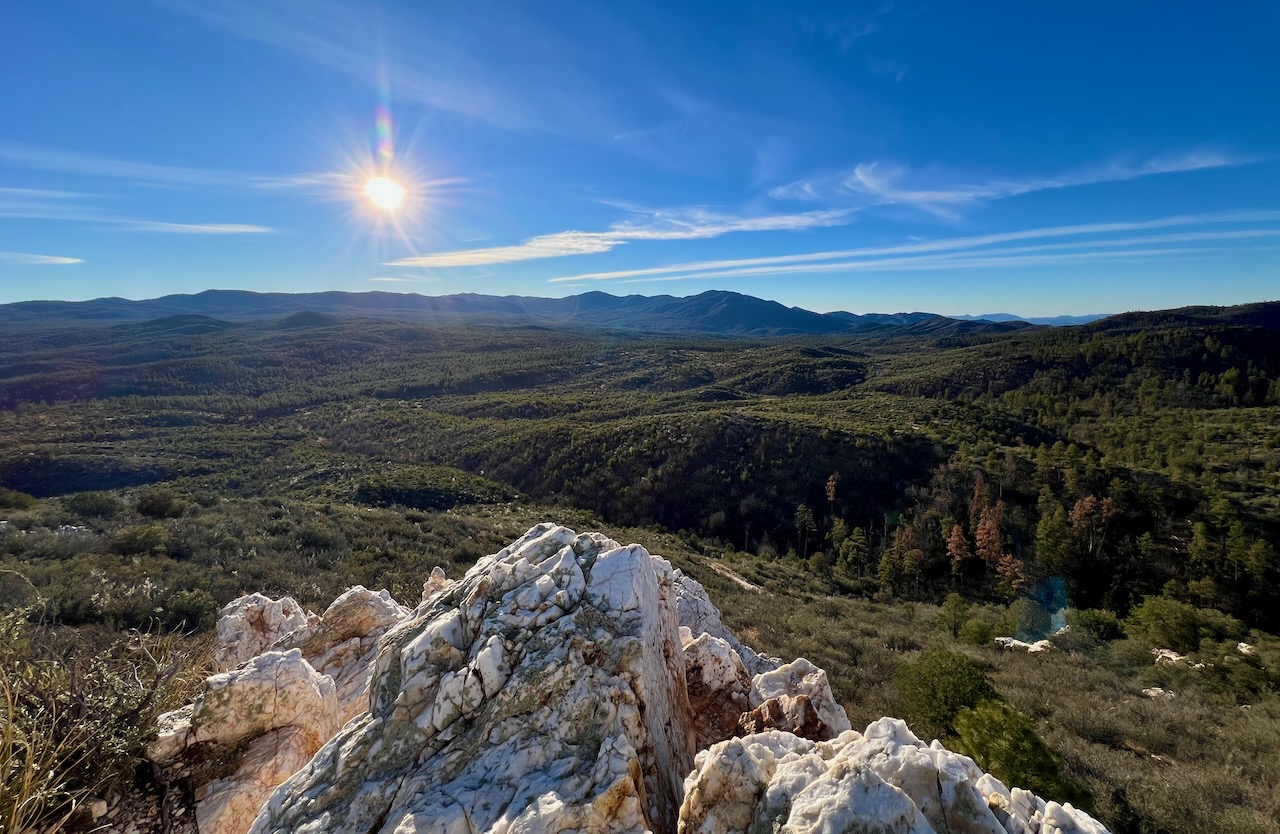
These rocks are pieces of an epoch-old puzzle in stone that predates any of the stories that would subsequently fit them into narratives of reverence, reverie, enclosure, extraction, and conservation.
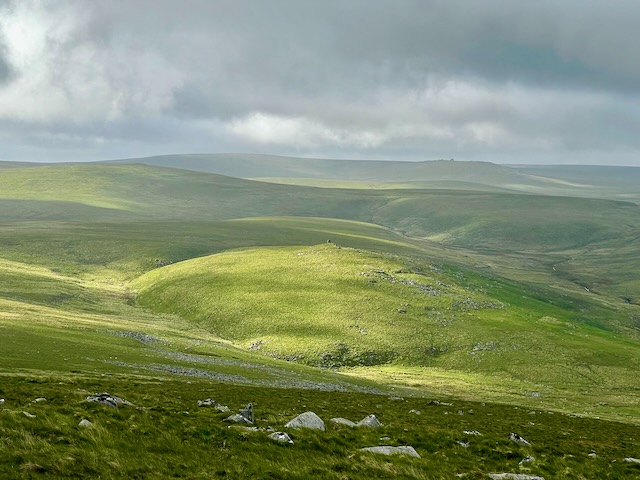
In my own reflections on this my fifty-fifth winter solstice, I find I’ve been drawn as much to this quartz’s sharp corners as I am to the rounded, besodden, deep green swales of Dartmoor on England’s southwestern coast — these hills, too, capped by aging granite tors (so captivating in their viridescence that I ran to more than 250 of them in my five years in the West Country). Dartmoor’s soft, rounded landscape is less about edges than envelopment; even atop the highest of tors, the misty weather is often resolutely introspective.
As we near the end of the year and settle in for longer, darker nights, and in this hemisphere, the tilt of the Earth seems to come closest in its orbit to the edge of possibility, I myself feel closest to this permeable edge. For a long time, I’ve been drawn to the blurriness of and richness of between-spaces — of land, of place, of culture, of genre, of time. In retrospect, this no doubt gave rise to my Climate Run project more than a decade ago; to seek out places in the Arctic and Subarctic (Iceland, Svalbard, The Faroes, Norway, Sweden, Finland, Newfoundland, and more) where the earth is more visible, mutable, and upon which our impact is often most clearly perceived.
Although our days have now grown longer in anticipation of the new year, in these shorter days, the mythic is often invoked and applied as a salve for the quotidian, and we invite the light into our long dark nights, the better to tell stories by; the thinning of this edge between things also invites a letting go.
December has also been witness in my own life to the births of both my son and of my late father, and though they were born 70 years and 5 days apart, and though they were bereft of more than two winter solstices together, there is between them a clear fluidity of time and experience that overspills its banks each year as our hemisphere starts its slow tilting back toward the sun. I am so deeply proud of them both, and can only aspire to live up to both my father’s past achievements and those my son has yet to do.
This season of solstice, celebration, and the turning of the year invites introspection, retrospection, and prospection of all kinds, with a turn toward speculation as we look ahead to this century’s second quarter, encouraged to consider what might be possible. As seductive as it may be to seek solutions to our present challenges in an aspirational future tense, our futures are always borne of our present, and in finding time to fully inhabit and embody our shared moments, angular or undulating as they may be.
 Ecologies of Knowing